
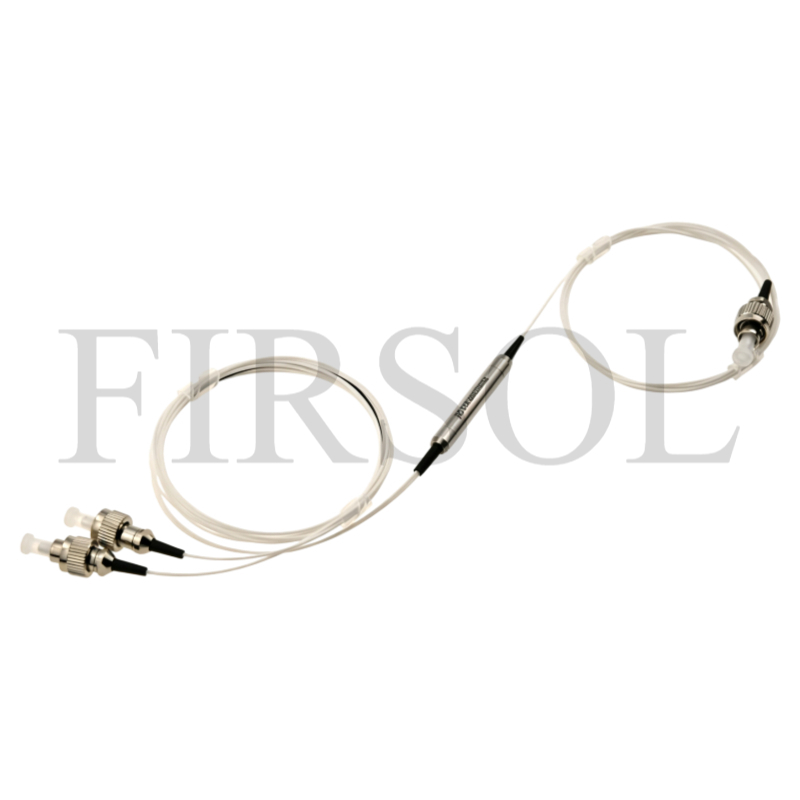
1310/1490/1550nm Single Mode Filter WDM
P/N: FIR-1310-1490-1550-SM-FIW|SKU: 10415
Total Price
$159.00 / unit
Production time varies based on product type, quantity, and customization level.
Below is a general estimate for most orders. For exact delivery time, please contact [email protected].
Shipping: FedEx / DHL / UPS Express · Tracking number provided after shipment
1310/1490/1550nm Single Mode Filter WDM
The 1310/1490/1550nm Single Mode Filter WDM is a thin film filter-based wavelength division multiplexer designed to combine or separate 1310nm, 1490nm, and 1550nm optical signals in single mode fiber systems. It provides low insertion loss, high channel isolation, low polarization dependent loss, and stable optical performance over a wide operating temperature range. This Filter WDM is suitable for PON networks, FTTH systems, optical communication links, CATV transmission, and other applications requiring reliable multi-wavelength signal management.
Specifications
Parameter | Unit | Value | |
|---|---|---|---|
Pass Channel Wavelength Range | nm | 1540~1620 | 1260~1500 |
Pass Channel Insertion Loss | dB | ≤0.6 | |
Pass Channel Isolation | dB | ≥30 | |
Reflect Channel Wavelength Range | nm | 1260~1500 | 1540~1620 |
Reflect Channel Insertion Loss | dB | ≤0.4 | |
Reflect Channel Isolation | dB | ≥15 | |
Polarization Dependent Loss | dB | ≤0.1 | |
Return Loss | dB | ≥50 | |
Max Optical Power (CW) | W | 0.3/1/5/10 | |
Fiber Type | - | SMF-28e | |
Tensile Load | N | 5 | |
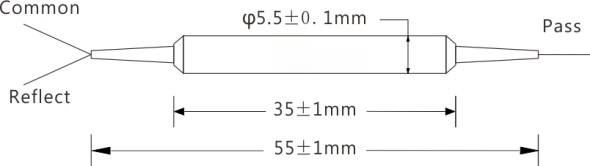
Package Dimensions | mm | Φ5.5 x L35 | |
Operating Temperature | °C | -5 to +70 | |
Storage Temperature | °C | -20 to +85 | |
Notes: Tested at 25 °C. Data exclude connectors. Adding connectors will increase insertion loss by approximately 0.3 dB, reduce return loss by 5 dB.
Dimensions
FAQ
- Q: What is a 1310/1490/1550nm Single Mode Filter WDM used for?
- A: A 1310/1490/1550nm Single Mode Filter WDM is used to combine or separate 1310nm, 1490nm, and 1550nm optical signals in a single mode fiber system. It is commonly used in PON, FTTH, CATV, optical communication, and test systems where multiple wavelengths need to be transmitted through the same fiber.
- Q: What are the typical port definitions?
- A: A standard Filter WDM usually includes three ports: Common, Pass, and Reflect. The Common port carries the combined wavelengths, while the Pass and Reflect ports are used to separate or combine the specified wavelength channels depending on the device configuration.
- Q: What is the difference between Filter WDM and Fused WDM?
- A: Filter WDM uses thin film filter technology, while Fused WDM uses fused biconical taper technology. Filter WDM generally provides better isolation, lower polarization dependent loss, better wavelength accuracy, and more stable performance, especially for applications requiring clear wavelength separation.
Questions & Answers
Can this product be used for both multiplexing and demultiplexing?
Yes. This Filter WDM is bidirectional and can be used for both multiplexing and demultiplexing. It can either combine different wavelengths into one fiber or separate combined wavelengths into different output ports.
Customer Reviews
No reviews yet. Be the first to review this product.
You May Also Like
1310/1550nm Single Mode Filter WDM
P/N: FIR-1310-1550-SM-FIW|SKU: 10420
1310/1550/1625nm Single Mode Filter WDM
P/N: FIR-1310-1550-1625-SM-FIW|SKU: 10460
C-Band Red/Blue Single Mode Filter WDM
P/N: FIR-CB-RB-SM-FIW|SKU: 10465
1064/1550nm Single Mode Filter WDM
P/N: FIR-1064-1550-SM-FIW|SKU: 10425
C-Band/L-Band Single Mode Filter WDM
P/N: FIR-CB-LB-SM-FIW|SKU: 10467
980/1550nm Single Mode Filter WDM
P/N: FIR-980-1550-SM-FIW|SKU: 10430
980/1064nm Single Mode Filter WDM
P/N: FIR-980-1064-SM-FIW|SKU: 10440
980/1030nm Single Mode Filter WDM
P/N: FIR-980-1030-SM-FIW|SKU: 10445
850/905nm Single Mode Filter WDM
P/N: FIR-850-905-SM-FIW|SKU: 10455