
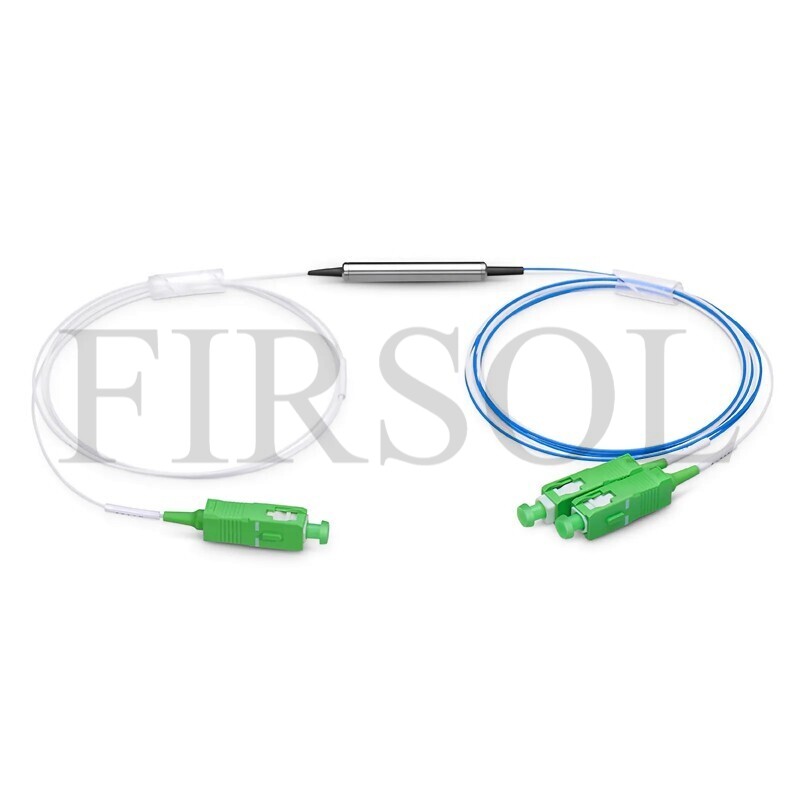
1550nm Polarization Beam Splitter/Combiner
P/N: FIR-1550-PBS/PBC|SKU: 10314
Total Price
$330.00 / unit
Production time varies based on product type, quantity, and customization level.
Below is a general estimate for most orders. For exact delivery time, please contact [email protected].
Shipping: FedEx / DHL / UPS Express · Tracking number provided after shipment
1550nm Polarization Beam Splitter (PBS)
The 1550nm Polarization Beam Splitter/Combiner (PBS/PBC) is a passive fiber optic polarization management device designed for separating or combining orthogonal polarization states at the 1550nm wavelength. It can split randomly polarized input light into two orthogonally polarized output signals, or combine two orthogonally polarized input signals into a single output fiber with low insertion loss and high extinction ratio.
Built with polarization-maintaining (PM) fiber technology, this 1550nm PBS/PBC provides excellent polarization performance, high directivity, and stable optical characteristics for demanding photonic systems. Port 1 and Port 2 are configured with PM fiber, while Port 3 can be configured with either single mode fiber (SMF) or all-PM fiber depending on application requirements.
With compact packaging, low insertion loss, and high reliability, the device is widely used in fiber lasers, optical amplifiers, coherent communication systems, optical sensing, polarization control systems, and PM fiber applications.
Specifications
Parameter | Unit | Value |
|---|---|---|
Center Wavelength | nm | 1550 |
Operating Wavelength Range | nm | ±40 |
Insertion Loss (Max.) | dB | 0.6 |
Return Loss (Min.) | dB | 50 |
Extinction Ratio (Min.) | dB | 22 |
Directivity (Min.) | dB | 50 |
Max Optical Power (CW) | W | 0.5/1/2/5/10 |
Fiber Type | - | Port 1 and Port 2 PMF; Port 3 SMF or All PMF |
Tensile Load | N | 5 |
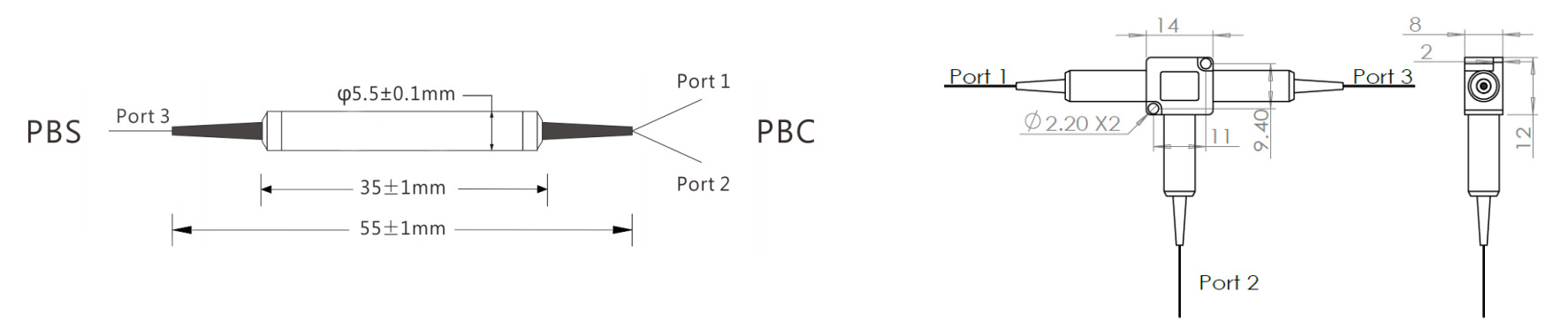
Package Dimensions | mm | Φ5.5 x L35 (<5W)/14 x 12 x 8 (>5W) |
Operating Temperature | °C | -5 to +70 |
Storage Temperature | °C | -40 to +85 |
Notes: Tested at 25 °C. Data exclude connectors. Adding connectors will increase insertion loss by approximately 0.3 dB, reduce return loss by 5 dB, and decrease extinction ratio by 2 dB. The fiber slow axis is aligned to the key by default.
Dimensions
FAQ
- Q: What is the difference between a Polarization Beam Splitter (PBS) and a Polarization Beam Combiner (PBC)?
- A: A Polarization Beam Splitter (PBS) separates orthogonal polarization states into two output ports, while a Polarization Beam Combiner (PBC) combines two orthogonally polarized input signals into a single output fiber. In most fiber optic systems, the same device can operate as either a PBS or a PBC depending on the direction of light propagation.
- Q: What does “Slow Axis Aligned to Port 1 Slow Axis” mean?
- A: It means the slow axis of Port 3 PM fiber is aligned parallel to the slow axis of Port 1 PM fiber. This configuration is commonly used in PM fiber laser systems and polarization-sensitive applications requiring consistent polarization orientation.
- Q: What does “Slow Axis Aligned 45° to Port 1 Slow Axis” mean?
- A: This option means the slow axis of Port 3 PM fiber is rotated 45° relative to the slow axis of Port 1. It is commonly used in polarization control, coherent systems, interferometers, and specialized PM fiber applications.
- Q: What is the difference between SMF output and All-PM output?
- A: SMF output configurations are more cost-effective and suitable for general applications. All-PM output configurations preserve polarization state throughout the entire optical path and are recommended for polarization-sensitive systems.
Questions & Answers
Can this device be used as both a splitter and a combiner?
Yes. PBS/PBC devices are reciprocal passive optical components. The same device can operate as either a polarization beam splitter or polarization beam combiner depending on the optical signal direction.
Customer Reviews
No reviews yet. Be the first to review this product.
You May Also Like
1480nm Polarization Beam Splitter/Combiner
P/N: FIR-1480-PBS/PBC|SKU: 10320
1310nm Polarization Beam Splitter/Combiner
P/N: FIR-1310-PBS/PBC|SKU: 10326
1064nm Polarization Beam Splitter/Combiner
P/N: FIR-1064-PBS/PBC|SKU: 10332
1030nm Polarization Beam Splitter/Combiner
P/N: FIR-1030-PBS/PBC|SKU: 10338
980nm Polarization Beam Splitter/Combiner
P/N: FIR-980-PBS/PBC|SKU: 10344
850nm Polarization Beam Splitter/Combiner
P/N: FIR-850-PBS/PBC|SKU: 10350
780nm Polarization Beam Splitter/Combiner
P/N: FIR-780-PBS/PBC|SKU: 10356
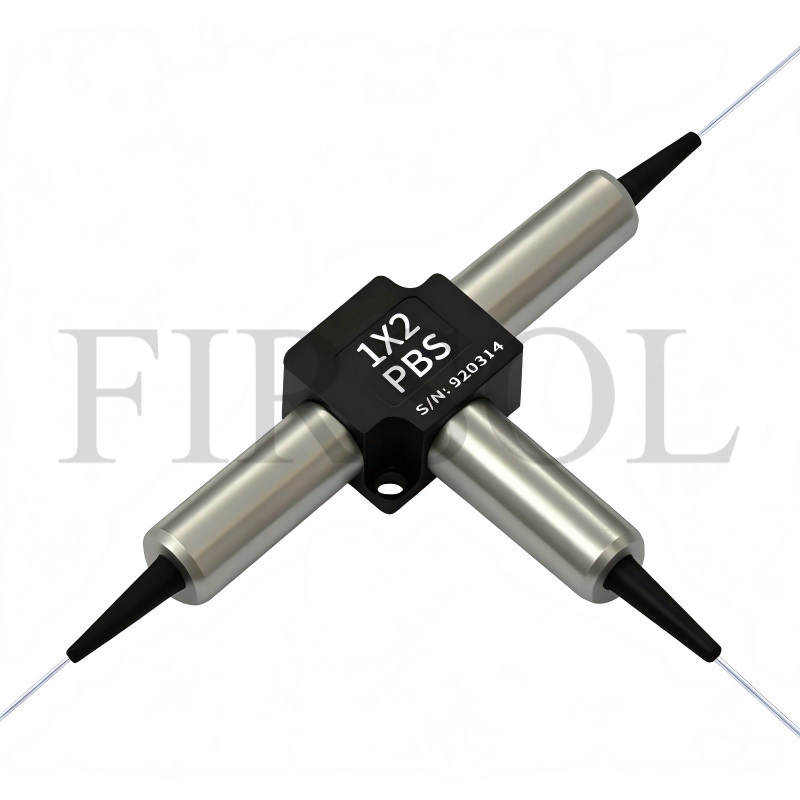
670nm Polarization Beam Splitter/Combiner
P/N: FIR-670-PBS/PBC|SKU: 10362
633nm Polarization Beam Splitter/Combiner
P/N: FIR-633-PBS/PBC|SKU: 10364
532nm Polarization Beam Splitter/Combiner
P/N: FIR-532-PBS/PBC|SKU: 10366