IPv4 vs IPv6: What It Means for Fiber Network Hardware Buyers
The Internet Protocol (IP) is the addressing and routing layer that moves data packets between devices — from a laptop to an Ethernet switch to a router at the far end of a fiber link. Today two versions run side by side: IPv4 and IPv6. If you specify or purchase network and fiber optic infrastructure, understanding the difference helps you choose equipment that will still be relevant a decade from now. This guide keeps the theory short and focuses on what actually matters when you buy.
What Is IPv4?
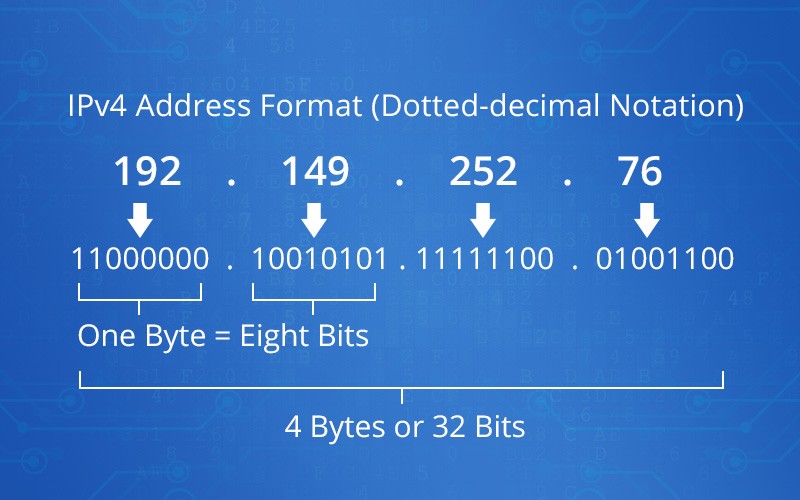
IPv4 (Internet Protocol version 4) was the first IP version deployed at global scale. Every connected device is assigned a unique address such as 192.168.1.1. IPv4 uses 32-bit addresses, giving roughly 4.3 billion unique addresses.
That sounded limitless in the early days, but the explosion of connected devices exhausted the free pools years ago. IANA allocated its last top-level IPv4 blocks in 2011, and the regional registries followed — the RIPE NCC (Europe/Middle East/Central Asia) ran out of freely available IPv4 in November 2019. That scarcity is one of the main reasons the IETF developed IPv6.
What Is IPv6?
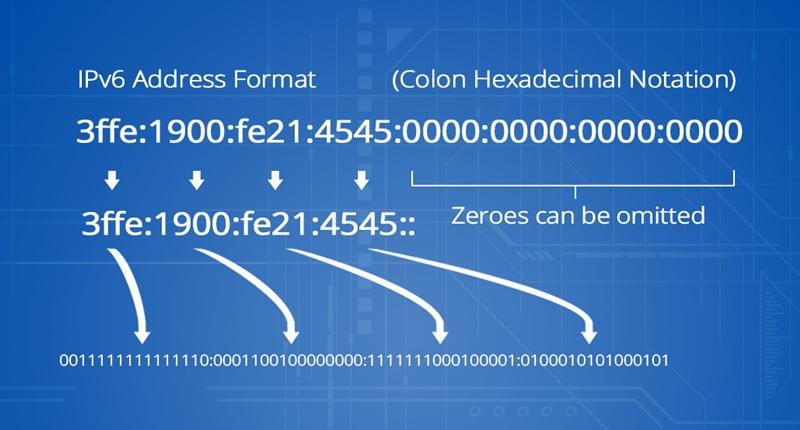
IPv6 (Internet Protocol version 6) is the successor designed by the Internet Engineering Task Force (IETF) to replace IPv4 and remove the address-shortage barrier to connecting new devices. IPv6 uses 128-bit addresses, which provides about 3.4 × 1038 addresses — a practically unlimited pool.
An IPv6 address is written as eight groups of four hexadecimal digits separated by colons, for example 2001:0db8:85a3:0000:0000:8a2e:0370:7334. Leading zeros can be dropped and one run of all-zero groups can be compressed to ::, so addresses are shorter in practice than they first appear.
IPv4 vs IPv6: The Core Differences
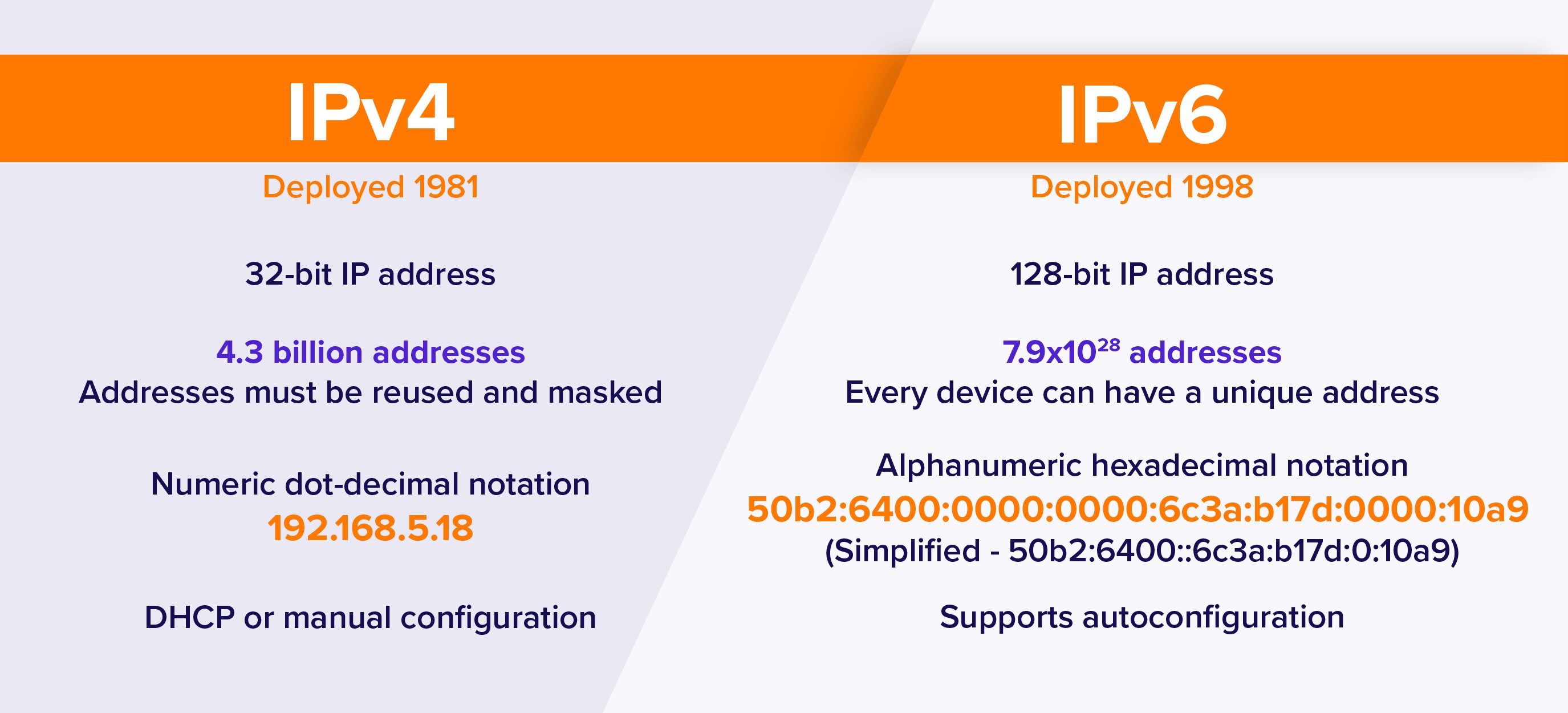
Both protocols identify devices on a network and follow the same basic principle, but they behave differently in ways that affect performance, security, and how you configure equipment.
Address Space & Performance
Moving from 32-bit to 128-bit addressing is the headline change. Beyond sheer quantity, IPv6 uses a hierarchical, CIDR-style structure that keeps global routing tables cleaner and can speed up routing decisions. It also removes the need for widespread NAT (Network Address Translation), restoring true end-to-end addressing.
IP Header
The IPv4 header is variable length (20–60 bytes) because of optional fields. The IPv6 header is a fixed 40 bytes with a simpler, streamlined layout; anything optional moves into extension headers. The result is more predictable, lower-overhead packet processing in routers and switches.
Security
With IPv4, IPsec is optional and bolted on. IPv6 was designed with IPsec support built into the protocol, and authentication and data-integrity mechanisms are first-class features. In practice this makes secure, authenticated communication easier to deploy consistently.
Deployment Reality
IPv4 had a decades-long head start, so it is still everywhere. IPv6 adoption grew slowly at first because of transition complexity and legacy-hardware compatibility, but it is now the majority path in many large networks. Most environments run dual-stack (IPv4 and IPv6 together), and tunneling lets IPv6 packets traverse IPv4 segments by encapsulating them — endpoints on both sides simply need to support both protocols.
IPv4 vs IPv6 Comparison Table
Attribute | IPv4 | IPv6 |
|---|---|---|
Address size | 32-bit (~4.3 billion) | 128-bit (~3.4 × 1038) |
Notation | Dotted-decimal (0–255), e.g. 192.168.1.1 | Colon-hexadecimal, e.g. 2001:db8::1 |
Address types | Unicast, multicast, broadcast | Unicast, multicast, anycast (no broadcast) |
Header length | Variable, 20–60 bytes | Fixed, 40 bytes + extension headers |
Header checksum | Yes | No (handled at other layers) |
Configuration | Manual or DHCP | Stateless auto-config (SLAAC) or DHCPv6 |
Address resolution | ARP (broadcast) | Neighbor Discovery (multicast) |
IPsec | Optional | Native support |
NAT | Commonly required | Generally not needed |
DNS reverse lookup | in-addr.arpa | ip6.arpa |
What This Means When You Buy Network & Fiber Hardware
The IPv4/IPv6 decision lives in the electronics and software layer, but it shapes the equipment you specify around your fiber plant. A few practical takeaways for procurement teams:
Insist on dual-stack support. Any new switch, router, or transceiver-hosting platform should handle IPv4 and IPv6 concurrently, so you are not forced into a rip-and-replace later.
Check management-plane IPv6. Confirm that device management, SNMP/monitoring, and firmware update paths work over IPv6, not just the data plane.
Separate the physical layer from the protocol. The passive optical layer — adapters, connectors, WDM filters, isolators, splitters — is protocol-agnostic. It carries light regardless of whether IPv4 or IPv6 rides on top, so quality fiber components protect your investment through the transition.
Plan headroom. IPv6 and dense multicast/anycast services often accompany higher data rates; make sure your passive components meet the insertion-loss and return-loss budgets your active gear needs.
In other words: choose active hardware that is fully IPv6-ready, and build it on a clean, low-loss passive fiber foundation.
Frequently Asked Questions
Will IPv6 replace IPv4 completely?
Eventually the industry is trending that way, but not overnight. For the foreseeable future the two coexist through dual-stack and tunneling, so both remain relevant.
Is IPv6 faster than IPv4?
Not inherently in raw speed, but its simpler fixed header and reduced reliance on NAT can lower processing overhead and improve routing efficiency, which helps in large, high-throughput networks.
Do fiber optic components need to be "IPv6 compatible"?
No. Passive fiber components (adapters, connectors, WDM/FWDM filters, isolators, splitters) operate at the optical layer and are independent of the IP version. IPv4/IPv6 support lives in the active transceivers, switches, and routers.
What is dual-stack?
Dual-stack means a device runs IPv4 and IPv6 simultaneously, so it can communicate with endpoints on either protocol. It is the most common migration strategy.
Summary
IPv6 expands the address space almost without limit, simplifies the packet header, bakes in security, and eases network configuration — which is why the long-term shift from IPv4 is inevitable. But IPv4 is not disappearing tomorrow, so the practical answer is dual-stack readiness. When you specify network hardware, prioritize IPv6-capable active equipment, and pair it with a high-quality, protocol-agnostic passive fiber layer so your infrastructure is ready for whatever the protocol landscape does next.