LPO vs NPO vs CPO: A Practical Guide to Optical Interconnects
AI and high-performance computing (HPC) are reshaping the data center from the inside out. As GPU clusters scale, aggregate bandwidth pushes past TB/s and rack power density climbs beyond 40 kW, the humble interconnect has quietly become one of the biggest bottlenecks in the system. Copper still wins on cost over very short runs, but it runs out of headroom fast once you need high bandwidth over any real distance. That pressure is driving a new wave of optical interconnect architectures — and three acronyms now dominate the conversation: LPO, NPO, and CPO.
This guide breaks down what each technology actually is, how it works, where it shines, and where it struggles — so you can match the right architecture to the right deployment instead of chasing buzzwords.
Why Traditional Pluggable Optics Are Hitting a Wall
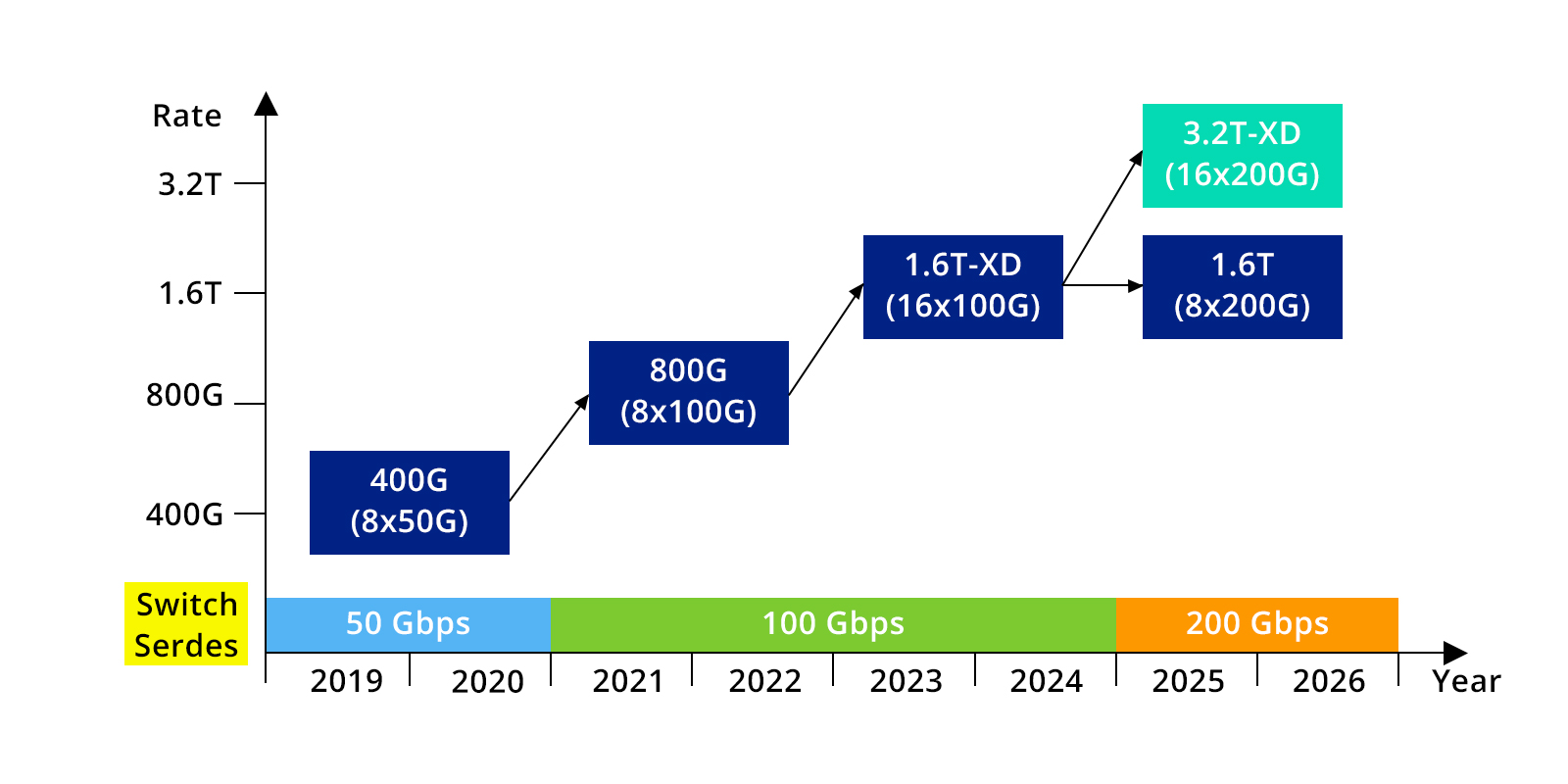
Pluggable optical modules have powered data center networking for years, and at 100G and 400G they still do the job well. The problem appears as line rates climb toward 800G, 1.6T and 3.2T, where three costs grow faster than the bandwidth:
Power. A 400G module built around a DSP draws roughly 30 W. Fill a switch with 48 of them and you are spending well over 1,400 W on optics alone — often 40% or more of the box’s total power budget.
Latency. Long electrical paths plus DSP retiming add delay that AI training and GPU-to-GPU traffic simply cannot afford.
Signal loss. Higher SerDes rates mean more attenuation across the board, demanding ever more aggressive compensation.
LPO, NPO and CPO each attack a different part of this problem. Rather than competing head-to-head, they form a layered roadmap: a near-term efficiency play, a mid-term transition, and a long-term performance ceiling.
LPO: Linear-Drive Pluggable Optics
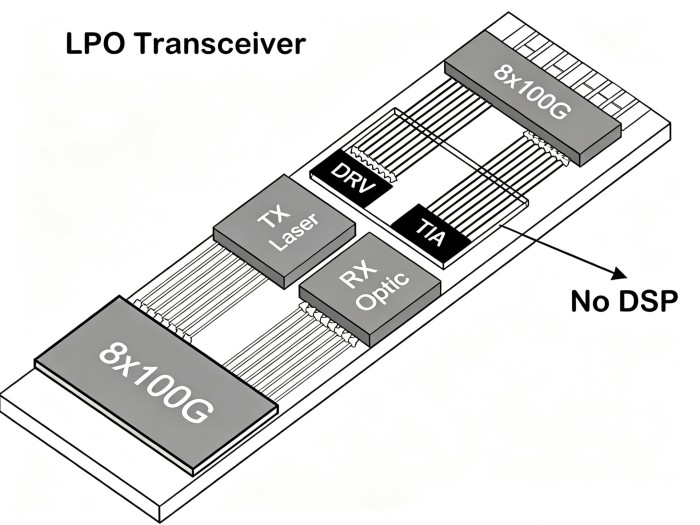
LPO (Linear-drive Pluggable Optics) keeps the familiar pluggable form factor but throws out the most power-hungry component inside it: the digital signal processor. First proposed around 2022, the idea is to build a purely analog “linear direct-drive” link with no DSP and no clock-data-recovery (CDR) stage.
How LPO Works
Where a conventional module relies on a DSP to equalize, retime and clean up the signal, LPO removes that block and shifts the burden elsewhere:
Transmit side: a high-linearity driver feeds the optical modulator directly, converting electrical to optical with no digital processing in between.
Receive side: a high-linearity transimpedance amplifier (TIA) handles photoelectric conversion and amplification while preserving the analog path.
Equalization: the compensation work the module’s DSP used to do now falls on the host xPU’s SerDes, which raises the bar for the host’s analog performance.
Where LPO Wins
Lower power: dropping the DSP cuts module power by roughly 30–50%, a direct win for PUE and energy cost.
Lower cost: the DSP can represent 20–40% of a module’s bill of materials, so removing it meaningfully reduces price even after beefing up the driver and TIA.
Lower latency: a shorter signal path is ideal for latency-sensitive GPU interconnect.
Serviceable: it keeps the hot-swappable pluggable design, so a failed module is a quick field replacement.
The Trade-offs
Short reach: without DSP error correction, bit error rate rises and reach is limited — typically a few meters to tens of meters today, with longer distances on the roadmap.
Standards still maturing: cross-vendor interoperability is weak, so LPO currently fits best inside single-vendor systems.
Host pressure: link stability leans heavily on host SerDes quality, which gets harder as rates move from 112G to 224G.
NPO: Near-Packaged Optics
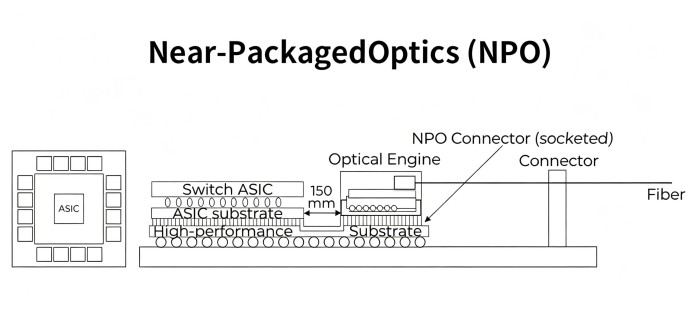
NPO (Near-Packaged Optics) sits between pluggables and CPO, and it is often described as the on-ramp to co-packaging. Instead of plugging optics into a front panel, NPO places the optical engine right next to the xPU (GPU, NPU or switch ASIC) on the same high-performance PCB or substrate, linked by very short electrical traces — usually a few centimeters, with channel loss held under about 13 dB.
What Makes NPO Different
NPO deliberately stops short of full integration. The optical engine and xPU stay separately packaged, which sidesteps the toughest co-packaging challenges while still escaping the limits of front-panel pluggables. That balance is why several hyperscalers have signalled NPO deployments as their preferred intra- and inter-cabinet approach in the 2026–2027 window.
Where NPO Wins
High bandwidth, low loss: the short path slashes attenuation and crosstalk, supporting 800G and beyond without heavy DSP compensation.
Better thermals: keeping optics out of the GPU’s hot zone avoids wavelength drift and gives engineers room to design cooling independently.
Field-replaceable: a faulty optical engine can be swapped without touching the expensive xPU.
Lower risk: NPO does not depend on bleeding-edge 3D packaging, so it reaches volume production sooner than CPO.
The Trade-offs
Density ceiling: it still needs substrate routing, so it can’t match CPO’s integration or its shortest-possible path.
High-speed strain: at 1.6T/3.2T, electrical loss and power climb, pushing materials, routing and interface standards harder.
Synchronization: at massive scale, keeping latency uniform across many NPO links becomes its own engineering task.
CPO: Co-Packaged Optics
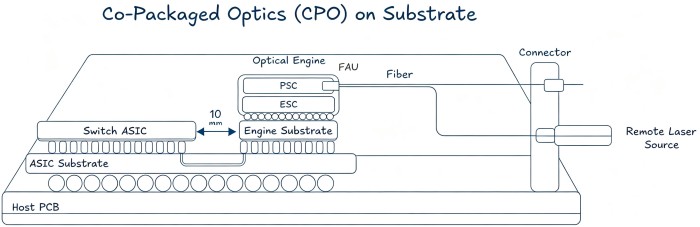
CPO (Co-Packaged Optics) is the logical endpoint of the NPO idea. Here the optical engine is integrated into the same package as the switch ASIC or compute chip, eliminating the front-panel module entirely. That collapses the electrical path from centimeters to millimeters and fundamentally improves signal integrity, power and latency at once. Mature silicon photonics is the enabler — it delivers the highly integrated, low-power optical engine CPO depends on.
How a CPO System Is Built
A typical CPO assembly combines an electrical chip, an optical engine, a silicon interposer and a fiber interface:
Transmit: the electrical chip’s SerDes drives high-speed signals across micro-bump interconnects on the interposer to the optical engine, where a driver and modulator perform electro-optical conversion onto the fiber.
Receive: a photodetector converts light back to current, a TIA amplifies it, and the signal returns to the electrical chip over the interposer for decoding.
By packaging depth, CPO is generally split into Type A (2.5D, electrical length up to ~10 cm), Type B (wafer-level 2.5D, higher density) and Type C (3D vertical stacking with millimeter-scale interconnects, the densest form).
Where CPO Wins
Massive bandwidth, minimal power: millimeter paths enable 1.6T–3.2T+ per port; industry figures suggest energy per bit can fall from 15–20 pJ/bit to roughly 5–10 pJ/bit.
I/O density: moving optics into the package frees the front panel and dramatically raises switch and GPU I/O density.
Ultra-low latency, high reliability: removing intermediate electrical links and DSP compensation cuts delay and reduces EMI sensitivity.
System efficiency: tighter integration trims conversion losses and improves overall data center PUE.
The Trade-offs
Packaging complexity: co-packaging optics and electronics demands exacting thermal, mechanical and yield control, raising manufacturing cost.
Hard to service: a single optical fault can mean replacing the whole package.
Young ecosystem: CPO needs new standards, test methods and automated manufacturing, and in the 1.6T era pluggables still cover most needs — so urgency is building rather than acute.
LPO vs NPO vs CPO: Side-by-Side Comparison
These three architectures are complements, not rivals. The table below summarizes how they line up across the factors that matter most when planning a deployment.
Factor | LPO | NPO | CPO |
|---|---|---|---|
Architecture | DSP-less pluggable module | Optical engine beside xPU, separate packages | Optics integrated into the ASIC/xPU package |
Power | ~50% below DSP modules | Below DSP, above CPO | Lowest (system-level) |
Latency | Low (no module DSP) | Lower than LPO | Lowest (shortest path) |
Reach | Short (~100 m, DR to ~500 m–2 km) | Intra/inter-cabinet (~10–100 m) | Ultra-short (cm) |
Density | Like standard pluggables | Higher than pluggables | Highest potential |
Serviceability | Easy (hot-swap) | Moderate (swap engine) | Hard (replace package) |
Vendor flexibility | High (MSA ecosystem) | Moderate | Low (single-vendor) |
Maturity | Shipping now (400G/800G) | Maturing (800G/1.6T) | Emerging (pre-commercial) |
Best for | Top-of-rack, short-reach spine-leaf | Mid-term cabinet interconnect | Future large AI clusters |
Choose LPO when cost-efficiency and low latency over short distances matter most — classic intra-rack and GPU-to-GPU links where you want to cut power today.
Choose NPO as a transition bridge that balances performance and maintainability — a low-risk path for 2026–2027 cabinet-scale interconnect.
Choose CPO when you are designing for the ceiling: ultra-large-scale AI and 3.2T+ interconnect where density and efficiency outrank serviceability.
Conclusion
The drive toward more bandwidth, less power and lower latency is rewriting how data centers connect. LPO delivers a pragmatic efficiency win for short reach, NPO balances performance with serviceability on the road to integration, and CPO pushes interconnect performance to its physical limits for the largest platforms of tomorrow. Understanding the strengths and limits of each is the key to making confident architecture decisions instead of betting on a single trend.
At Firsol, we track these shifts closely and support customers across the full optical interconnect stack — from pluggable transceivers to the passive components that keep next-generation links stable. If you are evaluating where LPO, NPO or CPO fit into your roadmap, our engineering team is happy to help you weigh the trade-offs for your specific deployment.
Frequently Asked Questions
What is the main difference between CPO and LPO?
CPO integrates the optical engine into the switch ASIC package to maximize bandwidth density and efficiency, while LPO simply removes the DSP from a standard pluggable to cut cost and power without changing the form factor.
Is LPO compatible with existing QSFP-DD and OSFP switches?
Yes. LPO retains QSFP-DD and OSFP form factors, so it can drop into existing AI data center switches without architectural changes.
Is silicon photonics a replacement for CPO or LPO?
No. Silicon photonics is a foundational integration technology that underpins CPO, LPO and even traditional pluggable modules — it is an enabler, not a competitor.
Which optical technology is best for AI training clusters?
Large-scale AI training generally favors CPO for its bandwidth density and energy efficiency, while LPO suits short-reach, cost-sensitive deployments.
Will CPO replace pluggable optics?
Most likely it will complement them. Different networking scenarios will continue to demand different optical architectures rather than a single winner.
Where does NPO fit between LPO and CPO?
NPO is the transition layer: more integrated and lower-latency than LPO, yet more maintainable and cost-effective than CPO — ideal for mid-term cabinet interconnect.