Hollow-Core Fiber Breaks the 0.1 dB/km Barrier: What It Means for Optical Networks
For decades, the lowest-loss optical fibers have relied on an exceptionally pure silica core. Engineers have continued refining these fibers, but their minimum attenuation has remained close to 0.14 dB/km at telecommunications wavelengths.
A new generation of hollow-core fiber may change that trajectory.
Researchers from Microsoft Azure Fiber and the University of Southampton have reported a hollow-core fiber with a measured attenuation of 0.091 dB/km at 1550 nm. The fiber also maintained attenuation below 0.2 dB/km across a 66 THz spectral window—substantially broader than the corresponding low-loss bandwidth of conventional silica-core telecommunications fiber.
The result does not mean that standard single-mode fiber will disappear. However, it demonstrates that guiding light primarily through air can overcome several long-standing limitations associated with transmitting light through solid glass.
From a Glass Core to an Air Core
Conventional single-mode fiber guides light through a solid silica core surrounded by glass with a slightly lower refractive index. Although silica is highly transparent at telecommunications wavelengths, light traveling through the glass is still affected by material absorption, Rayleigh scattering, chromatic dispersion and optical nonlinearities.
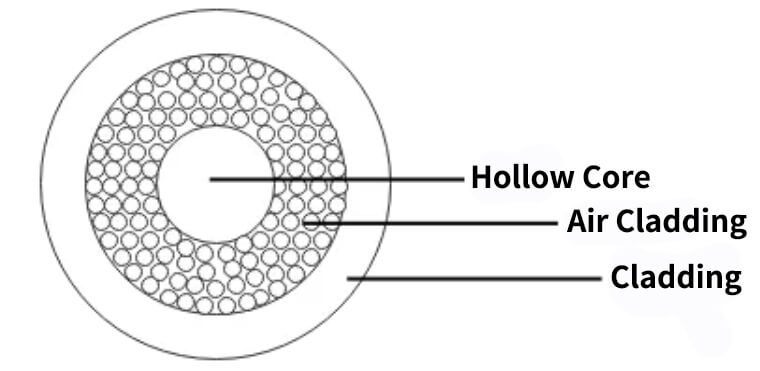
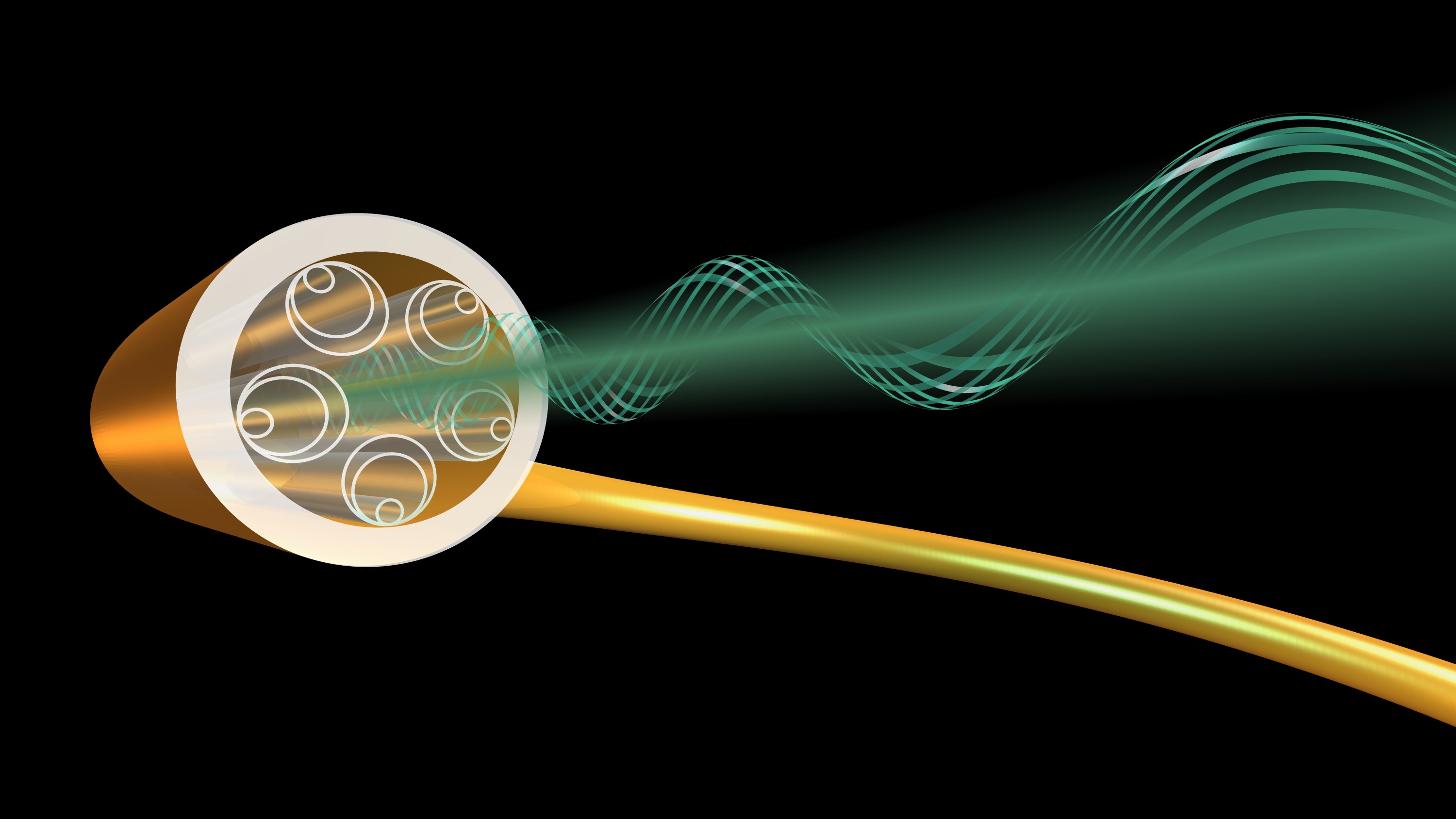
Hollow-core fiber takes a different approach. Most of the optical power travels through an air-filled central region rather than through solid glass. A carefully engineered glass microstructure surrounding the hollow core prevents the light from escaping.
The reported fiber uses a double-nested antiresonant nodeless fiber, or DNANF, structure. It contains multiple thin-walled glass tubes arranged around the central hollow core. These membranes create antiresonant conditions that strongly inhibit light from coupling out of the core and into the surrounding glass structure.
This distinction is important: modern DNANF hollow-core fibers do not primarily operate through the same photonic-bandgap mechanism associated with earlier generations of hollow-core photonic crystal fiber. Their guidance is more accurately described using antiresonance and inhibited coupling.
The Significance of 0.091 dB/km
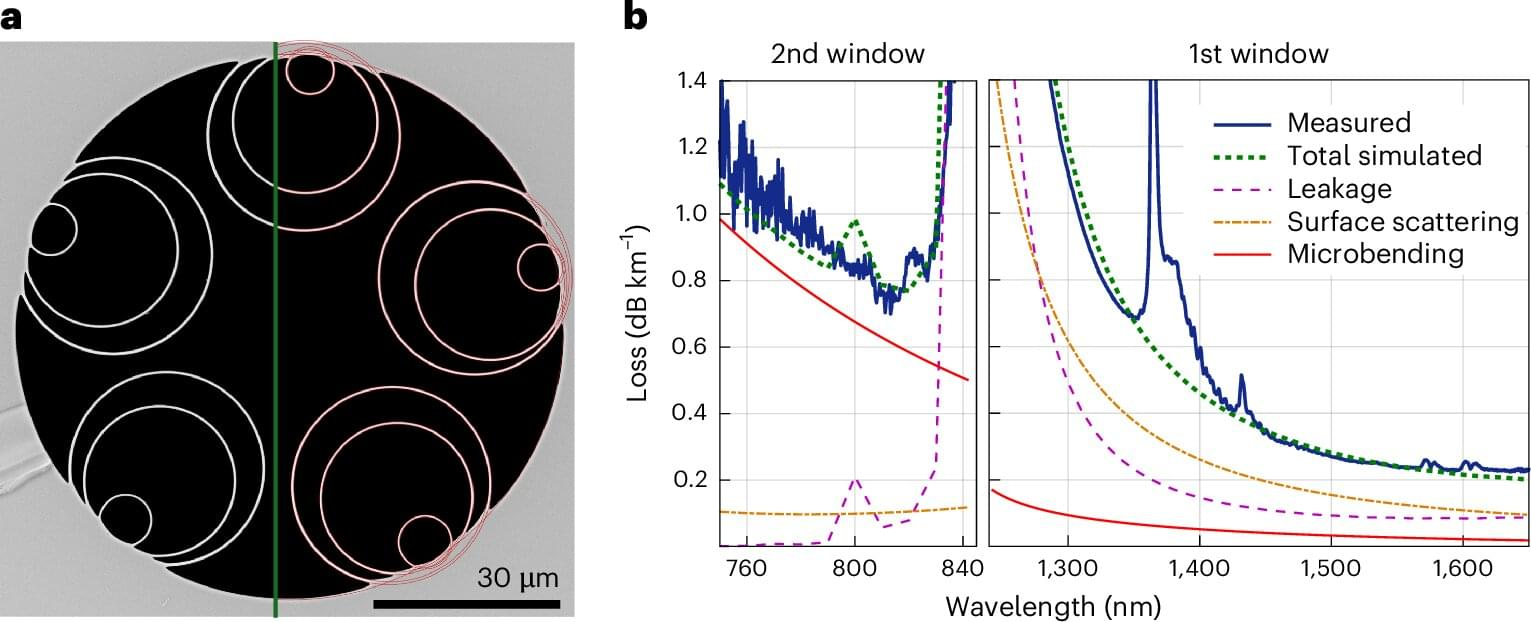
The research team measured an attenuation of 0.091 dB/km at 1550 nm in a 15-kilometer fiber. Attenuation remained below 0.1 dB/km from approximately 1481 to 1625 nm and below 0.2 dB/km across a much broader spectral range when narrow gas-absorption lines were excluded.
For comparison, the best reported solid-core silica fibers have achieved attenuation close to 0.14 dB/km at 1550 nm. That figure has changed relatively little for approximately four decades.
The difference may appear small when expressed per kilometer, but it becomes more significant over long distances.
Using a simplified 3 dB power-loss comparison:
At 0.14 dB/km, optical power falls by approximately 3 dB after about 21 kilometers.
At 0.091 dB/km, the same 3 dB reduction occurs after about 33 kilometers.
This does not mean that optical amplifiers must be installed every 21 or 33 kilometers. Amplifier spacing in a real transmission system depends on the total link budget, connector and splice losses, optical signal-to-noise ratio, modulation format, launch power and receiver performance.
Nevertheless, lower attenuation can support longer unamplified spans, reduce accumulated link loss and potentially lower the number or operating requirements of optical amplification sites.
Faster Propagation and Lower Latency
Light travels more slowly through silica than it does through air because silica has a higher refractive index. In a conventional fiber, the propagation speed is approximately 200 million meters per second. In a hollow-core fiber, where most of the optical field travels through air, the propagation speed can approach the speed of light in free space.
Microsoft describes hollow-core fiber as providing up to approximately 47% faster optical propagation and around one-third lower latency than conventional single-mode fiber over the same route.
These percentages describe two related but different quantities.
When propagation speed increases from roughly 204 million meters per second to close to 300 million meters per second, the increase in speed is approximately 47%. However, the corresponding reduction in travel time is closer to 32%.
For short connections, the difference may be measured in microseconds. Across metro, regional or long-haul networks, those microseconds can become relevant for applications such as:
Distributed AI and high-performance computing;
Data center interconnection;
Financial transaction networks;
Cloud services with strict latency requirements;
Real-time control and distributed computing;
Scientific instrumentation and synchronization.
Hollow-core fiber cannot eliminate processing, switching or routing delays, but it can reduce the propagation component of total network latency.
Broader Optical Bandwidth
Low attenuation at a single wavelength is only part of the reported achievement.
The hollow-core fiber maintained attenuation below 0.2 dB/km over a 66 THz window. By comparison, current high-performance silica telecommunications fibers provide a substantially narrower bandwidth at the same loss threshold.
A broader low-loss transmission window could allow future optical systems to use wavelength regions beyond the conventional C-band more efficiently. This may create additional capacity without relying exclusively on denser channel spacing or increasingly complex modulation formats.
However, fiber bandwidth alone does not determine usable system bandwidth. Optical amplifiers, transceivers, multiplexers, detectors and other components must also operate across the selected wavelength range. Commercial exploitation will therefore require development across the complete optical ecosystem.
Lower Chromatic Dispersion and Optical Nonlinearity
The researchers also reported substantially lower chromatic dispersion at 1550 nm than that of the reference solid-core fiber. Lower dispersion can reduce pulse broadening and simplify some forms of digital signal processing, depending on the transmission architecture.
Because only a small proportion of the optical field overlaps with glass, hollow-core fiber can also exhibit much lower optical nonlinearity than conventional silica fiber.
This characteristic is potentially important for high-capacity and high-power systems. In standard fiber, increasing launch power eventually produces nonlinear effects such as self-phase modulation, cross-phase modulation and four-wave mixing. These effects can distort the signal and limit transmission performance.
Reducing the interaction between light and glass may allow hollow-core systems to operate at higher optical powers before reaching comparable nonlinear limitations. The reported research indicates potential power-handling advantages of several orders of magnitude, although practical limits will depend on fiber design, contamination, termination methods and connected components.
Microsoft’s Move from Research to Live Networks
Hollow-core fiber is no longer confined entirely to laboratory experiments.
Microsoft acquired Lumenisity, a company originating from research at the University of Southampton, in December 2022. The acquisition was intended to accelerate the development and integration of hollow-core fiber into Microsoft’s cloud infrastructure.
Microsoft has since confirmed that hollow-core fiber is carrying live customer traffic in multiple Azure regions. One disclosed metro deployment connects two Azure data centers through two physically diverse routes, each exceeding 20 kilometers. The hybrid cables contain both hollow-core fibers and conventional single-mode fibers and support high-capacity DWDM transmission.
The deployment is important because it addresses more than fiber attenuation. A field-ready hollow-core system also requires:
Ruggedized outdoor cables;
Reliable fusion-splicing procedures;
Compatible joint closures;
Suitable patch cords and terminations;
Specialized inspection and test equipment;
Installation and maintenance processes;
Integration with existing DWDM transmission equipment.
Microsoft reports that its deployed routes have operated without field failures or outages and that additional Azure-region deployments are under development. These statements indicate meaningful progress, although they do not yet establish that hollow-core fiber is ready to replace conventional fiber across all network environments.
Where Hollow-Core Fiber Could Be Used
The strongest early opportunities are likely to be applications in which latency, bandwidth, optical power or nonlinear performance justifies the additional cost and operational complexity.
Data center interconnection
Metro data center links are a practical early application. They are long enough for propagation latency to matter, but controlled enough to support new cable, splicing and monitoring procedures.
AI and high-performance computing infrastructure
Large AI systems increasingly distribute computing, storage and accelerator resources across multiple facilities. Lower-latency optical links could help connect these resources more efficiently, particularly when data centers cannot be placed within the same physical campus.
Long-haul optical communications
Lower attenuation and wider bandwidth could reduce amplification requirements and expand the usable optical spectrum. However, long-haul deployment will require extensive testing of reliability, repairability, cabling, splicing and compatibility with existing line systems.
High-power laser delivery
Low interaction between the guided light and the surrounding glass may allow hollow-core fiber to transmit higher optical powers with reduced nonlinear effects. Potential uses include industrial laser delivery, scientific research and remote delivery of specialized wavelengths.
Sensing, spectroscopy and quantum research
Because gases or other materials can be introduced into the hollow core, these fibers are also useful for gas sensing, spectroscopy and light–matter interaction experiments.
Hollow-core fiber may also support certain quantum-optics and quantum-communication applications, including the transmission of wavelengths or optical states that are difficult to handle with standard silica fiber. These remain specialized research and development areas rather than evidence that a global “quantum internet” is imminent.
The Remaining Commercialization Challenges
The laboratory result is significant, but commercial performance depends on more than achieving record attenuation in a carefully manufactured fiber sample.
Manufacturing consistency
The fiber contains extremely thin membranes and complex nested glass structures. Small variations in tube dimensions, membrane thickness or longitudinal uniformity can affect attenuation, modal performance and bandwidth.
Scaling production while maintaining the required tolerances is considerably more difficult than producing mature conventional single-mode fiber.
Bending and installation performance
Hollow-core fibers must maintain their optical properties when cabled, installed, pulled through ducts and exposed to temperature changes and mechanical stress. Bend sensitivity and microbending must therefore be controlled through both fiber design and cable construction.
Splicing and connectorization
Joining hollow-core fiber to another hollow-core fiber—or to conventional single-mode fiber—requires carefully controlled interfaces. Splice loss, back reflection, contamination and structural deformation can all affect performance.
Gas and moisture control
Because the core is hollow, gases present inside the fiber can create narrow absorption lines. Commercial systems may require controlled fabrication, purging, sealing or compensation procedures.
Testing and fault location
Standard test procedures and instruments were developed primarily for solid-core fiber. Hollow-core networks may require adapted OTDR methods, calibration procedures and interpretation rules.
Cost and standardization
Conventional single-mode fiber benefits from decades of manufacturing optimization, globally standardized products and an extensive supply chain. Hollow-core fiber will need comparable progress in standards, interoperability, production capacity, field training and lifecycle cost before widespread adoption becomes practical.
Will Hollow-Core Fiber Replace Standard Single-Mode Fiber?
Not in the immediate future.
Standard single-mode fiber remains inexpensive, reliable, widely standardized and supported by a mature global ecosystem. For access networks, enterprise cabling, fiber-to-the-home systems and many conventional telecom links, it will remain the practical choice.
Hollow-core fiber is more likely to enter the market selectively. Initial deployment will focus on routes where its performance advantages justify the additional engineering requirements—for example, latency-sensitive data center interconnects, high-capacity cloud networks, specialized long-haul links and high-power optical systems.
Over time, improvements in manufacturing yield, cable design, splicing, testing and standardization may expand the range of economically viable applications.
Conclusion
The achievement of 0.091 dB/km attenuation represents an important milestone in optical waveguide technology. For the first time, a practical-length hollow-core fiber has demonstrated both lower minimum loss and broader low-loss bandwidth than the best conventional solid-core silica fibers.
Its potential advantages extend beyond attenuation. Faster optical propagation, lower latency, reduced chromatic dispersion, low nonlinearity and higher potential power handling could support new network architectures and specialized optical systems.
The central question is no longer whether hollow-core fiber can outperform silica fiber under laboratory conditions. It is whether manufacturers and network operators can reproduce that performance economically, reliably and at global scale.
Microsoft’s live Azure deployments suggest that the transition from research fiber to operational infrastructure has already begun. The next phase will be determined by manufacturing scale, field reliability, component compatibility and total deployment cost—not by attenuation records alone.