What Is an Optical Isolator?
An optical isolator is a passive fiber optic component that lets light pass in one direction (forward) while blocking light traveling in the reverse direction. It works like an optical “one-way valve” — the photonics equivalent of a diode in an electronic circuit. Its job is to protect sensitive sources such as laser diodes and optical amplifiers (EDFAs) from destabilizing back-reflections and back-scattered light.
Unwanted feedback into a laser cavity causes mode hopping, linewidth broadening, intensity noise, and in severe cases permanent damage. An isolator suppresses that feedback, keeping the source stable. This guide explains how isolators work and the main types.
How an Optical Isolator Works
An isolator relies on two physical principles: Malus’ law of polarized light and the Faraday magneto-optic effect (non-reciprocal polarization rotation). The core building block contains a Faraday rotator inside a permanent magnet, placed between two polarizers whose axes are offset by 45°.
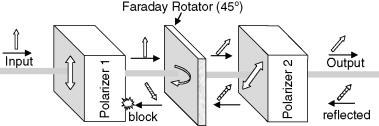
Forward direction: input light passes polarizer 1, is rotated exactly 45° by the Faraday rotator, and arrives perfectly aligned with polarizer 2 — so it transmits with low loss.
Reverse direction: reflected light enters through polarizer 2 and is rotated a further 45° in the same absolute direction (the rotation is non-reciprocal). It now sits at 90° to polarizer 1 and is blocked.
Because the Faraday rotation does not reverse with propagation direction (unlike a normal wave plate), forward and reverse light are treated differently — that non-reciprocity is what makes true isolation possible.
Free-Space vs In-line Isolators
Isolators are grouped by polarization dependence, which in practice maps to two package styles.
Attribute | Free-Space (Polarization-Dependent) | In-line (Polarization-Independent) |
|---|---|---|
Fiber pigtails | No (bulk optics / chip coupling) | Yes (fiber in and out) |
Input polarization | Must be well-defined | Any / random polarization |
PDL | Not relevant (polarized input) | Low PDL required |
Typical use | Semiconductor laser packages | Transmission lines, EDFAs |
Cost | Lower | Higher |
Free-space types suit semiconductor lasers because their output is already highly polarized. On live fiber links the polarization state drifts continuously, so polarization-independent in-line isolators with low PDL are required.
Firsol Optical Isolator Solutions
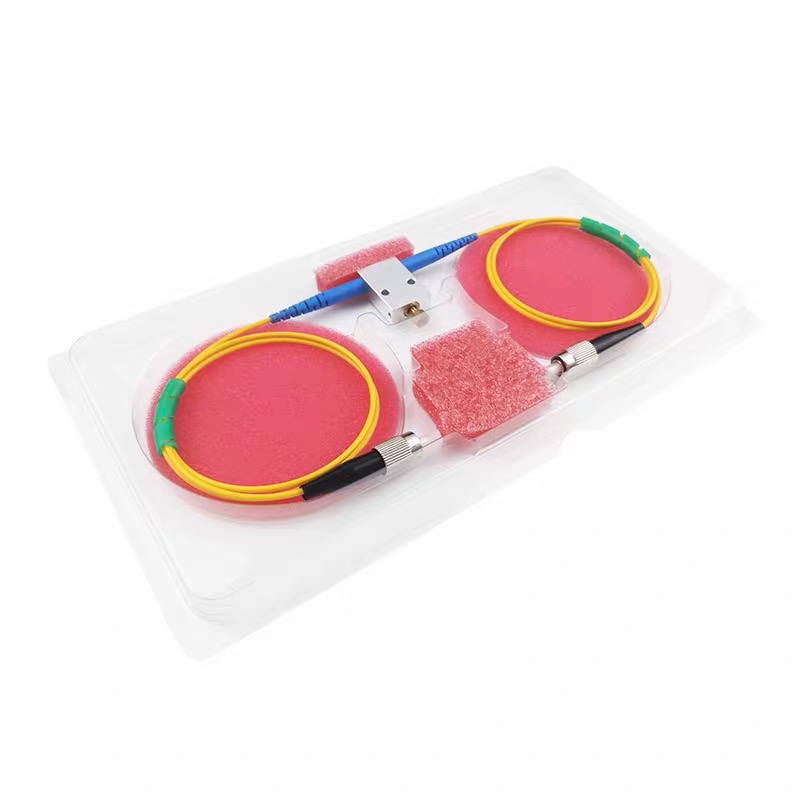
Firsol supplies both polarization-independent in-line and free-space optical isolators, in single-stage and dual-stage constructions, across 1310/1480/1550 nm bands with low insertion loss, high isolation, and low PDL/PMD. Polarization-maintaining (PM) and high-power variants are available for coherent and fiber-laser applications. Contact our team for datasheets, custom wavelengths, or a quote.
Frequently Asked Questions
Why does a laser need an optical isolator?
Back-reflected light re-entering a laser cavity causes instability — mode hopping, noise, and linewidth broadening — and can damage the source. An isolator blocks that feedback so the laser stays stable.
What is the difference between isolation and insertion loss?
Insertion loss is how much forward (wanted) light is lost passing through; isolation is how much reverse (unwanted) light is blocked. You want low insertion loss and high isolation.
When should I choose a dual-stage isolator?
When you need high isolation (≥ 50 dB) or wideband performance — typical in coherent links, high-power lasers, and amplifier stages. Single-stage is sufficient for general source protection.
What is a polarization-independent isolator?
An in-line isolator that works regardless of the input polarization state, which is essential on live fiber links where polarization drifts. It uses birefringent crystals to split and recombine polarization components.
Does an optical isolator work at any wavelength?
No. The Faraday rotation is tuned for a center wavelength, so isolation peaks near that band and falls off away from it. Specify the operating wavelength when ordering.