What Is a Faraday Mirror (FRM)? Working Principle, Specs & Applications
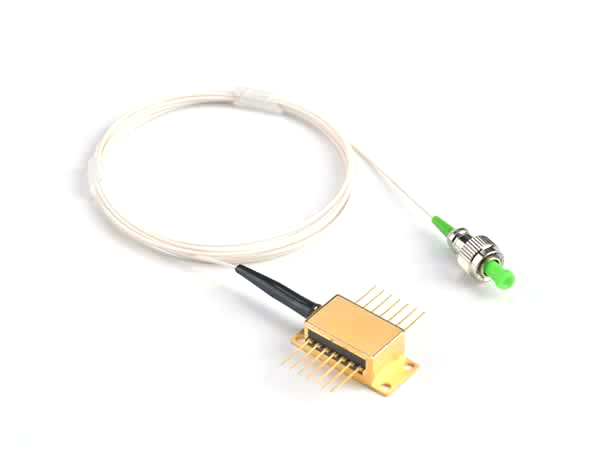
A Faraday mirror, more precisely a Faraday rotator mirror (FRM), is a fiber-pigtailed passive component that reflects an optical signal while rotating its polarization state by a total of 90 degrees. This non-reciprocal rotation makes the FRM unique: it automatically compensates for the random birefringence a beam accumulates as it travels through ordinary single-mode (SM) fiber, returning a clean, orthogonally polarized signal regardless of stress, vibration, or temperature drift along the path.
Because of this self-compensating behavior, the Faraday rotator mirror became a key enabler for building polarization-insensitive interferometers and PM-class performance using standard SM fiber — without the cost and handling difficulty of full polarization maintaining (PM) fiber systems. Today it is a core building block in fiber optic sensing, interferometry, and fiber laser cavities.
Why a Faraday Mirror Is Needed
An optical beam in a typical single-mode fiber undergoes random changes in birefringence caused by mechanical stress, bending, vibration, and temperature variation. As a result, the polarization state at the fiber output drifts unpredictably over time. One way to fight this is to use PM fiber and PM-fiber-based devices throughout the system, but historically these have been expensive and difficult to handle for many applications.
A Faraday rotator mirror solves the problem differently. Instead of trying to preserve a fixed polarization along the whole path, it undoes the accumulated birefringence on the return trip. The light that comes back is always orthogonal to the light that went in, so any polarization distortion picked up on the forward path is cancelled on the way back.
How a Faraday Mirror Works
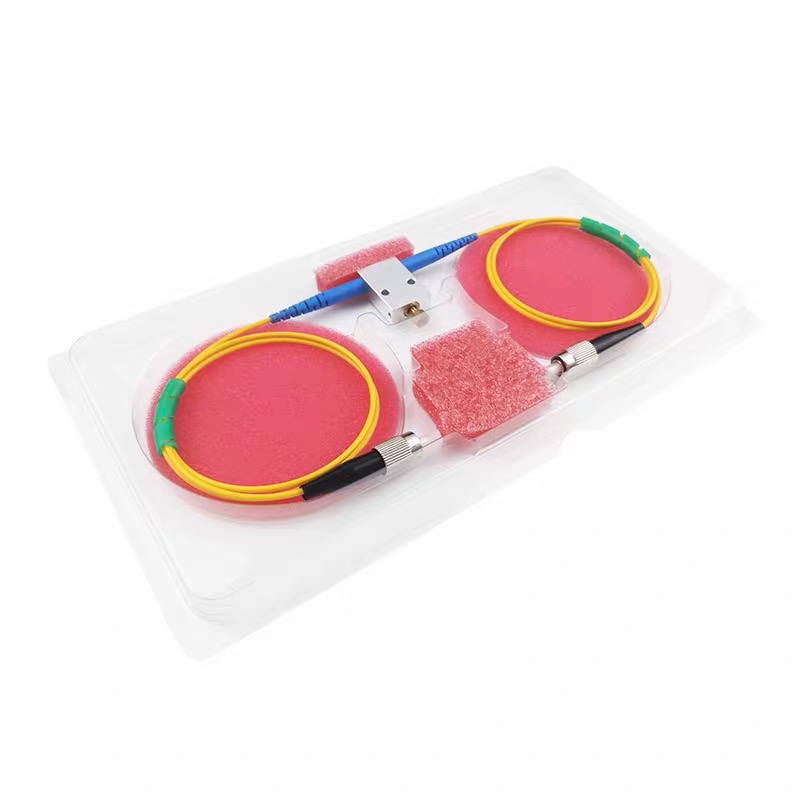
A Faraday rotator mirror typically consists of three elements packaged together: a fiber collimator, a Faraday rotator, and a reflective mirror.
The operation relies on the Faraday effect — a non-reciprocal rotation of the polarization state that occurs when light passes through a magneto-optic medium under an applied magnetic field. The key word is non-reciprocal: the rotation direction is fixed in space and does not reverse when the light travels backward.
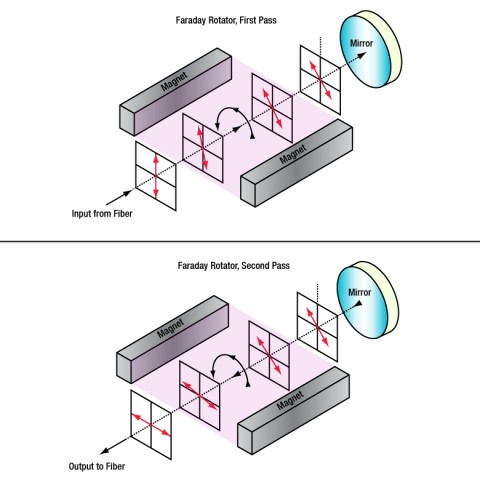
On the forward pass, the orthogonal field components rotate 45° in one direction as they pass through the Faraday rotator.
The mirror reflects the light back through the rotator.
On the return pass, the polarization rotates another 45° in the same spatial direction (because the device is non-reciprocal).
The total rotation is 90°, so the returning beam is linearly polarized orthogonal to the input — and any birefringence introduced by the fiber on the forward path is automatically compensated.
This 90-degree, phase-conjugate-like behavior is what allows an SM-fiber path with an FRM to behave as if it were polarization stable.
What a Faraday Mirror Is Made Of
The performance of a Faraday rotator depends heavily on the magneto-optic crystal at its core. A high-quality Faraday mirror uses Terbium Gallium Garnet (TGG), currently regarded as the best magneto-optical material for Faraday rotators and isolators in the near-infrared. TGG is preferred because of its high Verdet constant, strong Faraday effect, high thermal conductivity, and high resistance to laser-induced damage — making it suitable for higher optical power levels.
Key Specifications to Consider
As with any passive fiber component, the product name alone is not enough. Review the parameters below before specifying or ordering a Faraday rotator mirror.
Parameter | Typical Value | Why It Matters |
|---|---|---|
Operating Wavelength | 1310nm / 1550nm (or custom) | Faraday rotation is wavelength dependent; must match your band |
Rotation Accuracy | 90° ±1° (round trip) | Determines how well birefringence is compensated |
Insertion Loss (IL) | ≤0.6dB (max.) | Round-trip power lost through the device; lower is better |
Return Loss / Reflectivity | >95% reflectivity | How much signal is returned by the mirror |
Bandwidth | ±30nm typical | Window over which rotation and IL are guaranteed |
Fiber Type | SMF-28e / PM (custom) | SM is standard; PM available for specific designs |
Optical Power Handling | up to ~0.5W (higher on request) | TGG enables higher power tolerance |
Operating Temperature | -5°C to +70°C | Stability across the deployment environment |
For interferometric and sensing applications, rotation accuracy and low insertion loss are usually the highest priorities, since they directly affect how completely the birefringence is cancelled on the return path.
Faraday Mirror vs PM Fiber
A common question is whether you should simply use PM fiber instead. PM fiber maintains a launched polarization state along its length, but it is more expensive, harder to splice and handle, and requires careful axis alignment throughout the system. A Faraday rotator mirror takes the opposite approach: it lets you use ordinary, low-cost SM fiber and compensates for birefringence automatically on reflection. For double-pass architectures — such as reference and probe arms in interferometers — the FRM is often the simpler and more economical choice.
Typical Applications
Faraday rotator mirrors are used wherever a reflected, polarization-stable signal is required in a fiber path. Common applications include:
Fiber optic interferometers — as reference and probe mirrors that cancel polarization fading.
Fiber optic sensing — distributed and interferometric sensors that depend on polarization stability.
Fiber lasers — as cavity end mirrors providing defined polarization behavior.
Optical test and measurement — stable reflective references for lab and instrumentation setups.
Manufacturing passive PM-class components — enabling polarization-maintaining performance using SM fiber.
Frequently Asked Questions
Q1: Why does a Faraday mirror rotate polarization by 90 degrees?
The light passes through the Faraday rotator twice — once forward and once after reflection — rotating 45° each time. Because the Faraday effect is non-reciprocal, both rotations add in the same spatial direction for a total of 90°, producing an output orthogonal to the input.
Q2: What is the difference between a Faraday mirror and a Faraday rotator mirror (FRM)?
They refer to the same device. "Faraday rotator mirror" (FRM) is the more precise technical term, emphasizing that the component combines a Faraday rotator with a reflective mirror in one fiber-pigtailed package.
Q3: Why is TGG used in Faraday mirrors?
Terbium Gallium Garnet offers a high Verdet constant and strong Faraday effect in the near-infrared, plus high thermal conductivity and good resistance to laser damage. This combination makes it the preferred magneto-optic crystal for high-performance rotators and higher optical power levels.
Q4: Can I use a Faraday mirror with standard single-mode fiber?
Yes. One of the main advantages of an FRM is that it compensates for the random birefringence of standard SM fiber automatically, so you do not need PM fiber throughout the system. PM-fiber versions are available for specific designs on request.
Q5: How much optical power can a Faraday mirror handle?
Standard devices typically handle up to around 0.5W, and TGG-based designs can be specified for higher power on request. Always confirm the power rating against your laser or amplifier level when ordering.
Conclusion
A Faraday rotator mirror is a compact, fiber-coupled component that reflects light while rotating its polarization by 90 degrees, automatically cancelling the birefringence accumulated in standard single-mode fiber. By pairing a high-quality TGG rotator with low insertion loss and accurate rotation, it delivers polarization-stable, double-pass performance for interferometers, fiber sensors, and fiber lasers — without the cost and complexity of a fully PM-fiber system.
Firsol supplies Faraday rotator mirrors with custom operating wavelengths, fiber types, optical power levels, pigtail lengths, and connector options to match a wide range of fiber optic sensing, interferometry, and research requirements.