What Is Fiber Optics?
Fiber optics quietly powers almost everything we do online — streaming, cloud computing, video calls, and the data centers behind them. But for network builders and procurement teams, understanding how fiber actually works and which fiber type to specify is the difference between a link that performs for decades and one that needs costly rework.
This guide explains what fiber optics is, how light travels through glass, the difference between single mode and multimode fiber, and where each type — along with the connectors, adapters, and patch cables around it — fits into a real network. We’ll also cover a short history of who invented it, and finish with a practical buyer’s FAQ.
What Is Fiber Optics?
Fiber optics is the transmission of data as pulses of light through thin strands of glass (or, for short cheap links, plastic). Instead of sending electrical signals down copper, a laser or LED converts data into light, which travels through a fiber core to a receiver that converts it back into data.
Because light experiences far less loss and interference than electrical signals in copper, optical fiber delivers higher bandwidth over much longer distances — the foundation of modern telecom, internet backbones, and data-center interconnects.
How Does Fiber Optics Work?
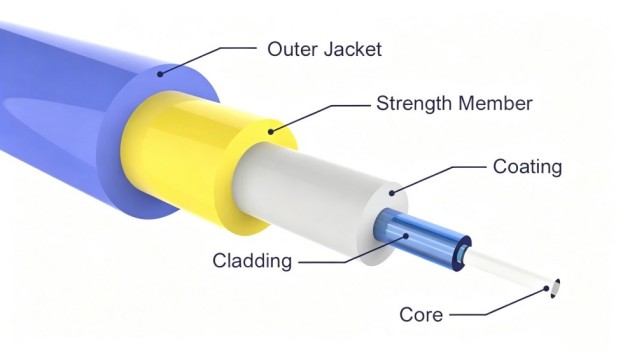
A fiber consists of a light-carrying core surrounded by a cladding with a slightly lower refractive index, all protected by a coating and jacket. When light enters the core at the right angle, the core-cladding boundary reflects it back inward. This effect — total internal reflection — keeps the light bouncing along the fiber with minimal loss, guiding it around bends and over long distances.
Signal quality is governed by two key metrics you’ll see on every datasheet:
Attenuation (dB/km) — how much optical power is lost per kilometer. Lower is better.
Bandwidth / dispersion — how much the signal spreads out over distance, which limits data rate and reach.
Single Mode vs Multimode Fiber
There are two main families of optical fiber, defined by how many paths (“modes”) light can travel down the core:
Single mode fiber (SMF) — a very small ~9 µm core lets light follow a single path. Lower attenuation and virtually unlimited bandwidth make it the choice for long-distance, high-capacity, and carrier links.
Multimode fiber (MMF) — a larger 50 or 62.5 µm core lets light travel multiple paths at once. Cheaper optics and easier alignment make it ideal for short reaches inside buildings and data centers.
Attribute | Single Mode (OS2) | Multimode (OM3/OM4/OM5) |
|---|---|---|
Core diameter | ~9 µm | 50 µm (62.5 µm legacy) |
Wavelengths | 1310 / 1550 nm | 850 / 1300 nm |
Light source | Laser | VCSEL / LED |
Attenuation | ≤ 0.4 dB/km (OS2) | ~3 dB/km (850 nm) |
Typical reach | Tens to 100+ km | Up to ~400–550 m (10G/OM4) |
Cost per link | Higher optics, cheaper fiber | Cheaper optics, pricier fiber |
Best for | Long-haul, metro, FTTx, DWDM | LAN, data center, short interconnects |
Cables, Connectors, and Adapters
Raw fiber rarely ships on its own. A working link is built from several layers of hardware:
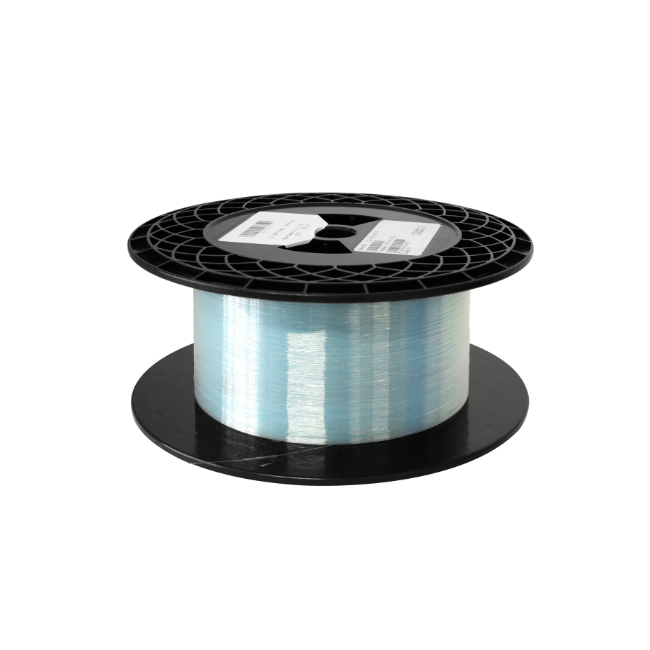
Bare optical fiber — the glass strand itself, wound on spools for manufacturing patch cords, pigtails, and specialty assemblies.
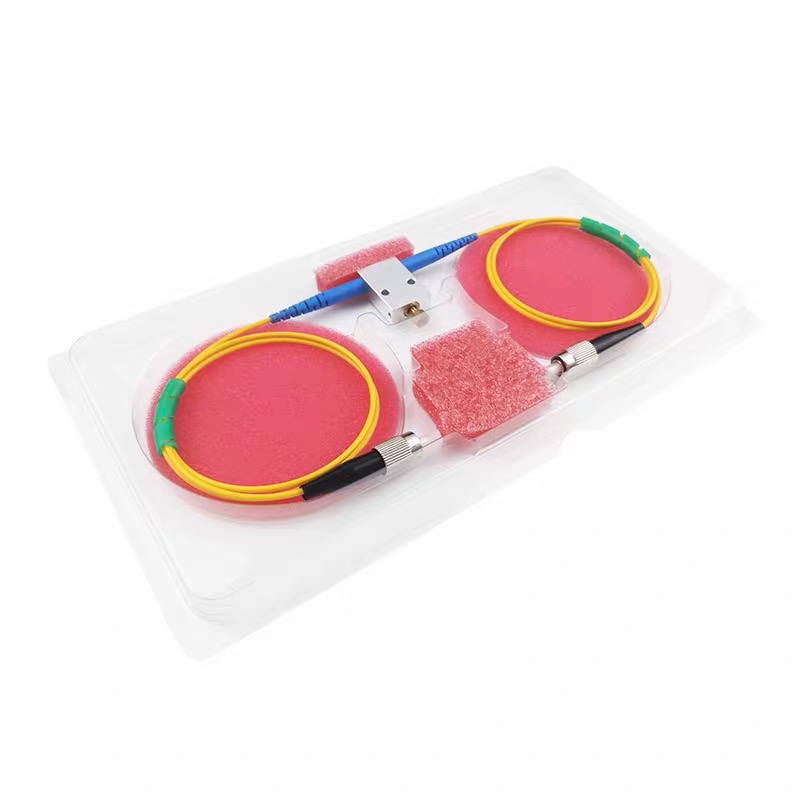
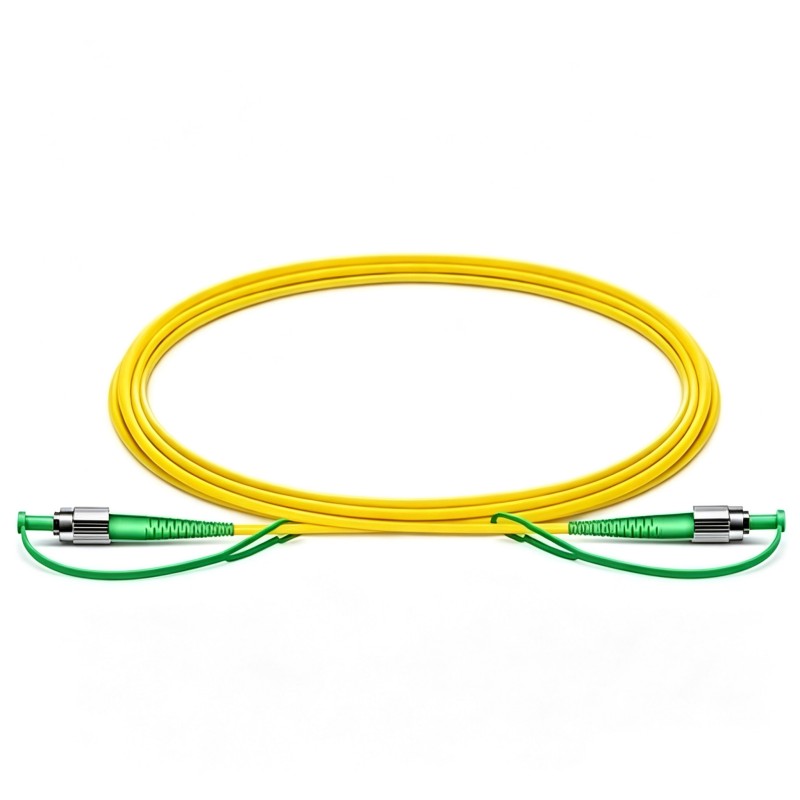
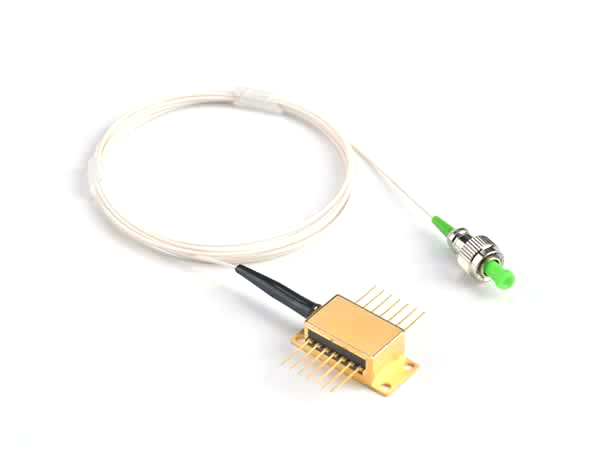
Patch cables (jumpers) & pigtails — terminated fiber assemblies used to connect equipment, patch panels, and enclosures.
Connectors — LC, SC, and FC end-faces that mate two fibers together with low insertion loss and high return loss.
Adapters — couplers that align two connectors face-to-face inside panels and cassettes.
Think of it as a chain: bare fiber → cabled fiber → patch cords / pigtails → connectors & adapters. Every component has to match the fiber type (single mode or multimode) and polish to preserve signal quality.
Where Fiber Optics Is Used
Telecom & internet backbones — long-haul and metro transport using single mode fiber and DWDM.
FTTx / broadband access — bringing single mode fiber to homes and businesses.
Data centers — high-density multimode and single mode links between switches and servers.
Enterprise LANs & campuses — multimode backbones between buildings and floors.
Industrial, medical, and sensing — specialty fibers for harsh or precision environments.
A Short History: Who Invented Fiber Optics?
Two names stand out. Narinder Singh Kapany, an India-born physicist working in the UK and later the US, is widely called the “father of fiber optics” for his early-1950s work demonstrating image and light transmission through bundled glass fibers, published in Nature in 1954.
Charles Kuen Kao is regarded as the father of fiber-optic communications. In a landmark 1966 paper with George Hockham, Kao showed that if glass could be made pure enough to reach around 20 dB/km of attenuation, fiber could carry telecom signals over practical distances. That insight guided the development of the ultra-low-loss fiber we use today and earned Kao a share of the 2009 Nobel Prize in Physics.
How to Choose the Right Fiber
For most buyers the decision comes down to distance, data rate, and budget:
Long distance or future-proof capacity → single mode (OS2).
Short reaches inside a building or data center on a tight budget → multimode (OM3/OM4/OM5).
Always match connector type, polish, and fiber grade end-to-end — mismatches drive up insertion loss.
Firsol Fiber & Connectivity Products
Firsol supplies the full passive fiber chain, from bare glass to finished assemblies:
Single Mode Optical Fiber and Multimode Optical Fiber — bare fiber on spools.
Corning® Optical Fiber — premium branded glass.
Fiber Patch Cables — single mode and multimode jumpers and pigtails.
Fiber Connectors (LC / SC / FC) and Fiber Adapters — low-loss termination and coupling.
Need help specifying the right fiber and connectivity for your link? Contact our engineering team for a datasheet or quote.
Frequently Asked Questions
Is fiber optic made of glass or plastic?
Telecom and data-center fiber is made from ultra-pure silica glass. Plastic optical fiber (POF) exists for very short, low-cost links, but it has far higher attenuation and limited bandwidth.
What is the difference between single mode and multimode fiber?
Single mode has a tiny ~9 µm core for one light path, giving lower loss and longer reach. Multimode has a larger 50/62.5 µm core for many paths, which is cheaper for short distances but limited in reach.
How far can fiber optic signals travel?
Single mode fiber can carry signals tens to over a hundred kilometers without regeneration; with amplifiers and DWDM, much farther. Multimode is typically limited to a few hundred meters depending on data rate.
Can I mix single mode and multimode fiber?
No. The core sizes and optics differ, so mixing them causes severe loss. Keep the fiber type, connectors, and transceivers consistent across a link.
Who invented fiber optics?
Narinder Singh Kapany pioneered fiber optics in the 1950s, and Charles Kuen Kao established the basis for low-loss fiber-optic communications in 1966, later winning the 2009 Nobel Prize in Physics.