1x2 DWDM Filter Explained: Single Mode vs PM, 50/100/200GHz Guide
In dense wavelength division multiplexing systems, accurate wavelength selection is critical for adding, dropping, separating, or combining optical channels. A 1x2 DWDM filter is a compact three-port optical device designed for this purpose. It is widely used in DWDM transmission systems, optical amplifiers, fiber optic communication networks, coherent optical systems, and polarization-sensitive test setups.
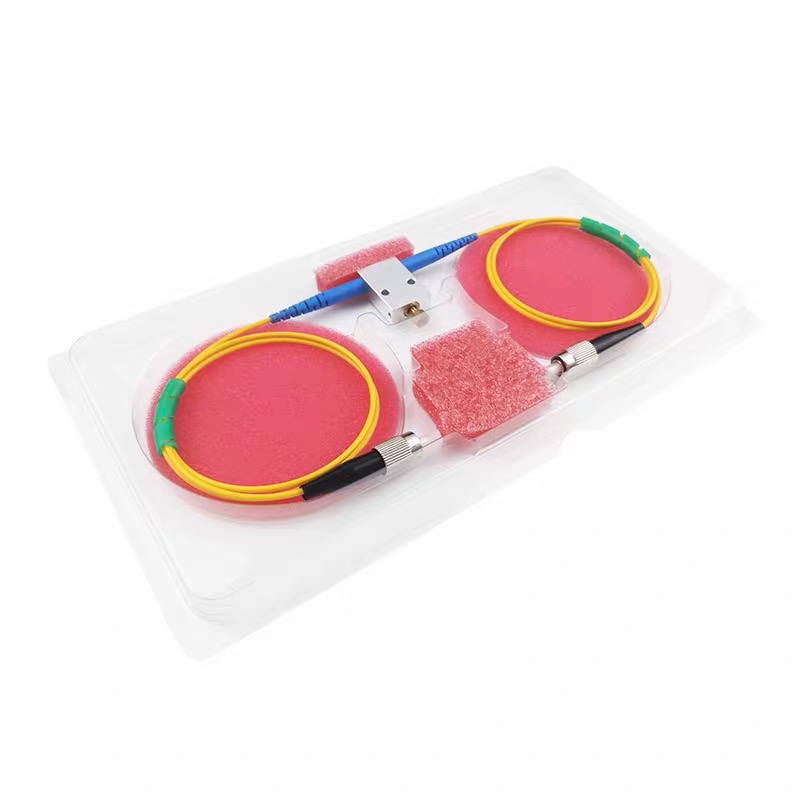
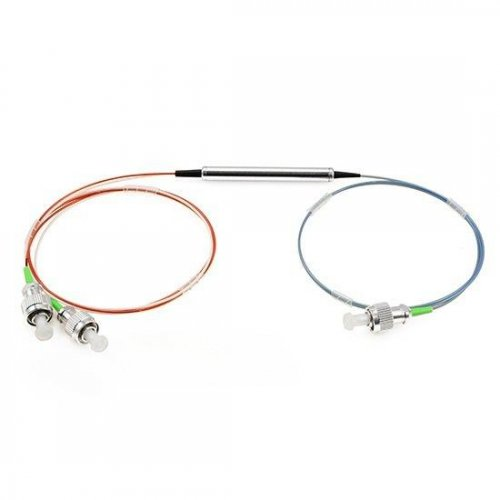
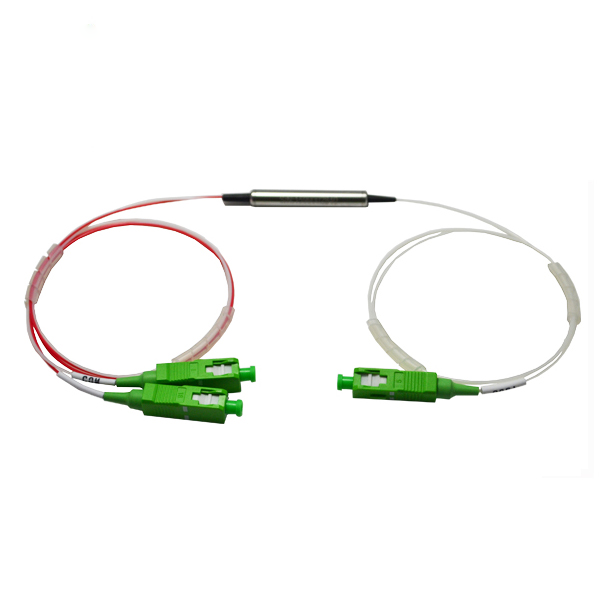
A typical 1x2 DWDM filter consists of one common port and two branch ports. It can extract a selected ITU DWDM channel from a multi-wavelength optical signal, or add a specific DWDM channel into the main optical path while allowing other wavelengths to continue through the other port. In practical applications, this type of device is often used as a single-channel add/drop filter, wavelength-selective filter, or compact DWDM filter module.
Firsol offers both Single Mode 1x2 DWDM Filters and Polarization Maintaining (PM) 1x2 DWDM Filters, with 50GHz, 100GHz, and 200GHz channel spacing options. The single mode version uses SMF-28e fiber, while the PM version uses PM1550 fiber and is designed to preserve the polarization state of the optical signal.
How a 1x2 DWDM Filter Works
A 1x2 DWDM filter normally has three optical ports: Common, Pass, and Reflect. The common port carries the multi-wavelength signal. The pass port is used for the selected DWDM channel, while the reflect port carries the remaining wavelengths.
When used as a drop filter, a multi-channel DWDM signal enters the common port. The filter selects one ITU channel and routes it to the pass port, while the other wavelengths are reflected to the reflect port. When used as an add filter, the selected channel can be added into the main optical path through the same wavelength-selective principle. This makes 1x2 DWDM filters ideal for systems where only one wavelength channel needs to be inserted or extracted without disturbing the rest of the DWDM traffic.
50GHz vs 100GHz vs 200GHz: What Is the Difference?
Channel spacing is one of the most important specifications of a DWDM filter. Firsol's 1x2 DWDM filter series supports 50GHz, 100GHz, and 200GHz options. Use the table below to compare key performance parameters at a glance.
Specification | 50GHz | 100GHz | 200GHz |
|---|---|---|---|
Channel Passband (min.) | 0.20nm @ -1dB | 0.22nm @ -0.5dB | 0.5nm @ -0.5dB |
Pass Channel IL (max.) | 0.8dB | 1.0dB | 0.9dB |
Reflect Channel IL (max.) | 0.4dB | 0.6dB | 0.5dB |
Pass Channel Isolation (min.) | 30dB | 30dB | 30dB |
Reflect Channel Isolation (min.) | 13dB | 13dB | 13dB |
PM Extinction Ratio (min.) | 18dB | 18dB | 20dB |
Typical Application | High-density DWDM | Standard DWDM (most common) | Wider-passband / low-density |
In general, 50GHz is suitable for high-density DWDM systems, 100GHz is the standard and most widely used option, and 200GHz is suitable for less dense systems or applications requiring a wider passband.
Single Mode 1x2 DWDM Filter
A Single Mode 1x2 DWDM Filter is designed for standard single mode fiber systems. It focuses on wavelength selection, low insertion loss, high channel isolation, and stable long-term optical performance.
Firsol's single mode version supports ITU grid channels with pass channel options such as C01, C02, C03, and custom wavelengths. The device is available with maximum optical power options of 0.3W, 1W, 2W, 5W, and 10W, and uses SMF-28e fiber. Package dimension is Φ5.5 x L35mm, with an operating temperature range of -5°C to +70°C. This version is suitable for general DWDM transmission systems, wavelength division systems, fiber optic amplifiers, and optical communication networks.
Polarization Maintaining 1x2 DWDM Filter
A Polarization Maintaining 1x2 DWDM Filter performs the same add/drop and wavelength selection function, but is designed for systems where polarization state matters. Compared with the standard single mode version, the PM version must maintain consistency in the slow or fast axis direction while still providing wavelength selectivity, low insertion loss, and high channel isolation.
Firsol's PM version uses PM1550 fiber, supports Both Axis operation, and provides a high extinction ratio: 18dB for 50GHz/100GHz and 20dB for 200GHz options. It also supports maximum optical power options of 0.3W, 1W, 2W, 5W, and 10W. The PM version is suitable for PM fiber communication systems, fiber lasers, optical amplifiers, coherent optical systems, polarization-sensitive test setups, and PM DWDM add/drop modules.
Single Mode vs Polarization Maintaining: Which One Should You Choose?
Criteria | Single Mode (SM) | Polarization Maintaining (PM) |
|---|---|---|
Fiber Type | SMF-28e | PM1550 |
Polarization Control | No | Yes (slow / fast axis) |
Extinction Ratio | N/A | ≥18dB (50/100GHz), ≥20dB (200GHz) |
Typical Use Cases | Telecom DWDM, EDFA, FTTH backbone | Fiber lasers, coherent systems, interferometers |
Cost | Lower | Higher |
Recommended When | Standard SMF networks | Polarization stability is required |
Choose a Single Mode 1x2 DWDM Filter for standard single mode fiber networks. Choose a PM 1x2 DWDM Filter when your system uses PM fiber, fiber lasers, coherent detection, or other polarization-sensitive optical paths.
Key Specifications to Consider
When selecting a 1x2 DWDM filter, the product name alone is not enough. Buyers should check several key parameters before ordering:
Channel spacing — 50GHz for high density, 100GHz for standard systems, 200GHz for wider tolerance.
Pass channel wavelength — C01, C02, C03, or custom ITU grid channels.
Insertion loss — lower IL reduces power budget pressure on long-distance or amplifier links.
Channel isolation — Firsol guarantees ≥30dB pass isolation and ≥13dB reflect isolation.
Extinction ratio & axis alignment (PM only) — slow axis aligned to key by default. Adding connectors may increase IL by ~0.3dB, reduce RL by 5dB, and decrease ER by 2dB.
Optical power handling — 0.3W / 1W / 2W / 5W / 10W options for different system designs.
Typical Applications
1x2 DWDM filters are used wherever a specific DWDM channel needs to be added, dropped, separated, or combined. Common applications include DWDM transmission systems, optical amplifiers (EDFA / Raman), fiber laser systems, coherent optical systems, and laboratory test setups. For telecom and data transmission, the single mode version is usually sufficient. For laser systems or polarization-sensitive environments, the PM version is the better choice.
Frequently Asked Questions
Q1: What is the difference between the pass port and reflect port?
The pass port outputs the selected ITU DWDM channel, while the reflect port carries all the remaining wavelengths. In add/drop modules, the pass port is the "dropped" or "added" channel.
Q2: Can a 1x2 DWDM filter handle high optical power?
Yes. Firsol's 1x2 DWDM filters are available with optical power ratings up to 10W, which is suitable for high-power EDFA, Raman amplifier, and fiber laser systems. Specify the power requirement when ordering.
Q3: Do I need a PM version if my system uses standard single mode fiber?
No. PM filters are only needed when the system actively requires polarization control — typically in fiber lasers, coherent detection, or interferometric setups. For standard SMF telecom links, the single mode version is more cost-effective.
Q4: Can a 1x2 DWDM filter be used bidirectionally as both add and drop?
Yes. The filter's wavelength-selective behavior is reciprocal, so the same device can drop a channel in one direction and add a channel in the reverse direction.
Q5: What channel spacing should I choose for a new build?
For most new DWDM networks, 100GHz is the standard default — it balances channel density, optical performance, and component cost. Choose 50GHz only when you need higher channel count, and 200GHz when wider passband tolerance is acceptable.
Conclusion
A 1x2 DWDM filter is a compact and efficient solution for selecting a specific ITU DWDM channel in optical networks. The single mode version is suitable for general DWDM systems, while the PM version is designed for PM fiber systems where polarization stability is required.
Firsol provides 50GHz, 100GHz, and 200GHz 1x2 DWDM filters with custom pass channel wavelengths, optical power levels, pigtail lengths, pigtail diameters, and connector options to support different DWDM system requirements.