What Is an ONT? How an Optical Network Terminal Works in Fiber Networks
When fiber reaches a home, office, apartment building, or cell site, the optical cable does not normally connect directly to a laptop or an ordinary Ethernet router. A subscriber-side device must terminate the optical access link and present interfaces that local equipment can use. That device is commonly called an optical network terminal, or ONT.
The basic description - "an ONT converts light into electrical data" - is useful, but incomplete. A modern ONT also participates in the passive optical network (PON) protocol, registers with the service provider, follows upstream transmission timing, supports security and service mapping, reports alarms, and may provide Ethernet, voice, Wi-Fi, or other subscriber interfaces.
This guide explains where an ONT sits in a fiber access network, how downstream and upstream transmission work, and how an ONT differs from an ONU, OLT, modem, router, and integrated gateway.
QUICK ANSWER An ONT is a powered device at or near the subscriber premises that terminates a PON connection. It receives downstream optical signals from the provider, delivers the subscriber's services through Ethernet or other user ports, and sends upstream optical bursts in time slots assigned by the OLT. |
Where Does an ONT Fit in a Fiber Network?
An ONT is one part of a larger PON system. The three fundamental sections are the optical line terminal (OLT), the optical distribution network (ODN), and the subscriber-side ONU or ONT.
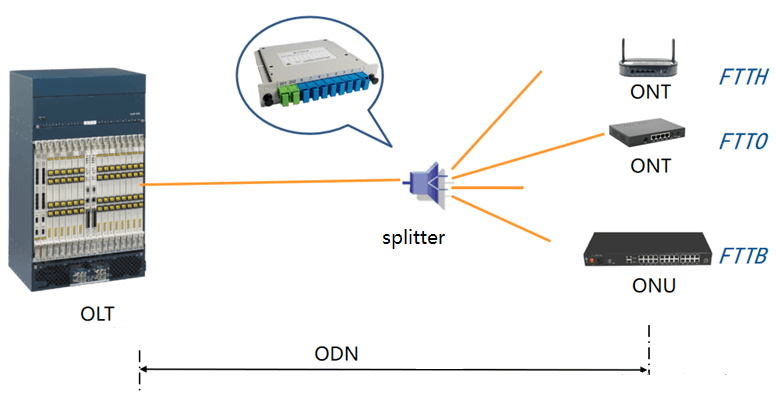
Optical line terminal (OLT): The provider-side platform located in a central office, headend, point of presence, or access site. One OLT PON interface communicates with multiple subscriber devices.
Optical distribution network (ODN): The fiber infrastructure between the OLT and subscribers. It can include feeder, distribution, and drop fibers, passive optical splitters, connectors, adapters, splice closures, and distribution boxes.
Optical network terminal (ONT): The active device at the subscriber side. It terminates the optical protocol and presents user network interfaces such as Ethernet or voice.
OLT > Feeder Fiber > Passive Optical Splitter > Drop Fiber > ONT > Router or User Devices
The word passive describes the distribution network between the OLT and subscriber devices: ordinary splitters and fiber links do not require electrical power to route the signal. The ONT itself is an active device and therefore needs power.
How Does an ONT Work?
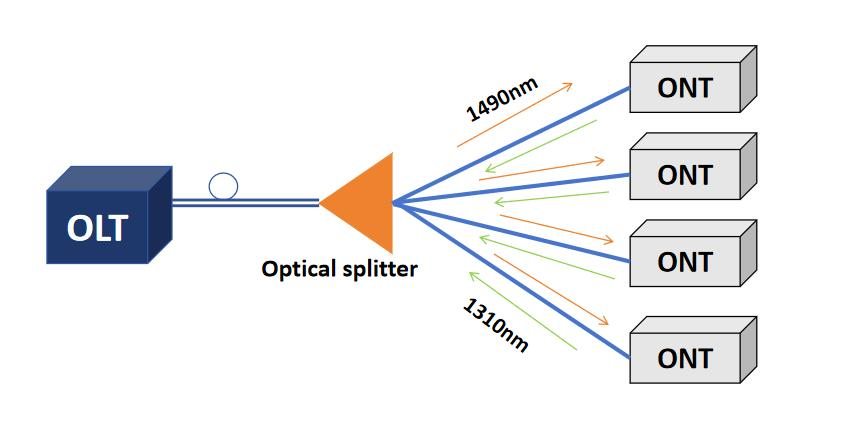
A PON uses one optical line to serve multiple endpoints through passive splitting. Downstream and upstream communication therefore operate differently.
1. Downstream: From the OLT to the ONT
The OLT sends a continuous downstream optical signal through the feeder fiber. A passive splitter divides the optical power among its output ports, so the downstream transmission reaches every ONT on that PON branch. Each ONT processes the protocol information and accepts only the traffic assigned to it. Encryption and logical identifiers help keep subscriber traffic separated.
Inside the ONT, the optical receiver detects the incoming signal, the PON chipset processes the frames, and the service-processing functions map the subscriber's data to Ethernet, voice, or other supported interfaces.
2. Upstream: From the ONT to the OLT
Multiple ONTs share the same upstream fiber path, so they cannot all transmit at the same time. The OLT measures the timing of each endpoint and assigns upstream transmission opportunities. Each ONT then sends a short optical burst within its allocated window. This time-division multiple-access process prevents bursts from different subscribers from colliding at the OLT receiver.
Dynamic bandwidth allocation allows the OLT to adjust upstream capacity according to service profiles and traffic demand rather than reserving a fixed portion of bandwidth for every ONT at all times.
3. Registration, Management, and Service Delivery
Before delivering service, an ONT normally must be discovered, authenticated, configured, and authorized by the operator. Depending on the network, this can involve a serial number, password, LOID, vendor profile, and OMCI configuration. The OLT can then provision user ports, VLANs, service profiles, quality-of-service rules, and alarms.
An ONT therefore performs more than optical-to-electrical conversion. Typical functions include:
Optical termination: Transmit and receive at the wavelengths and power levels required by the PON standard.
Protocol termination: Process PON framing, ranging, synchronization, and upstream burst timing.
Subscriber identification: Register and authenticate the endpoint according to the operator's provisioning method.
Traffic and service mapping: Deliver Internet, voice, business Ethernet, or other services to the correct user interfaces.
Security: Support downstream encryption and operator-defined access controls.
Monitoring: Report optical levels, equipment status, port statistics, and alarms to the management system.
ONT vs. ONU: What Is the Real Difference?
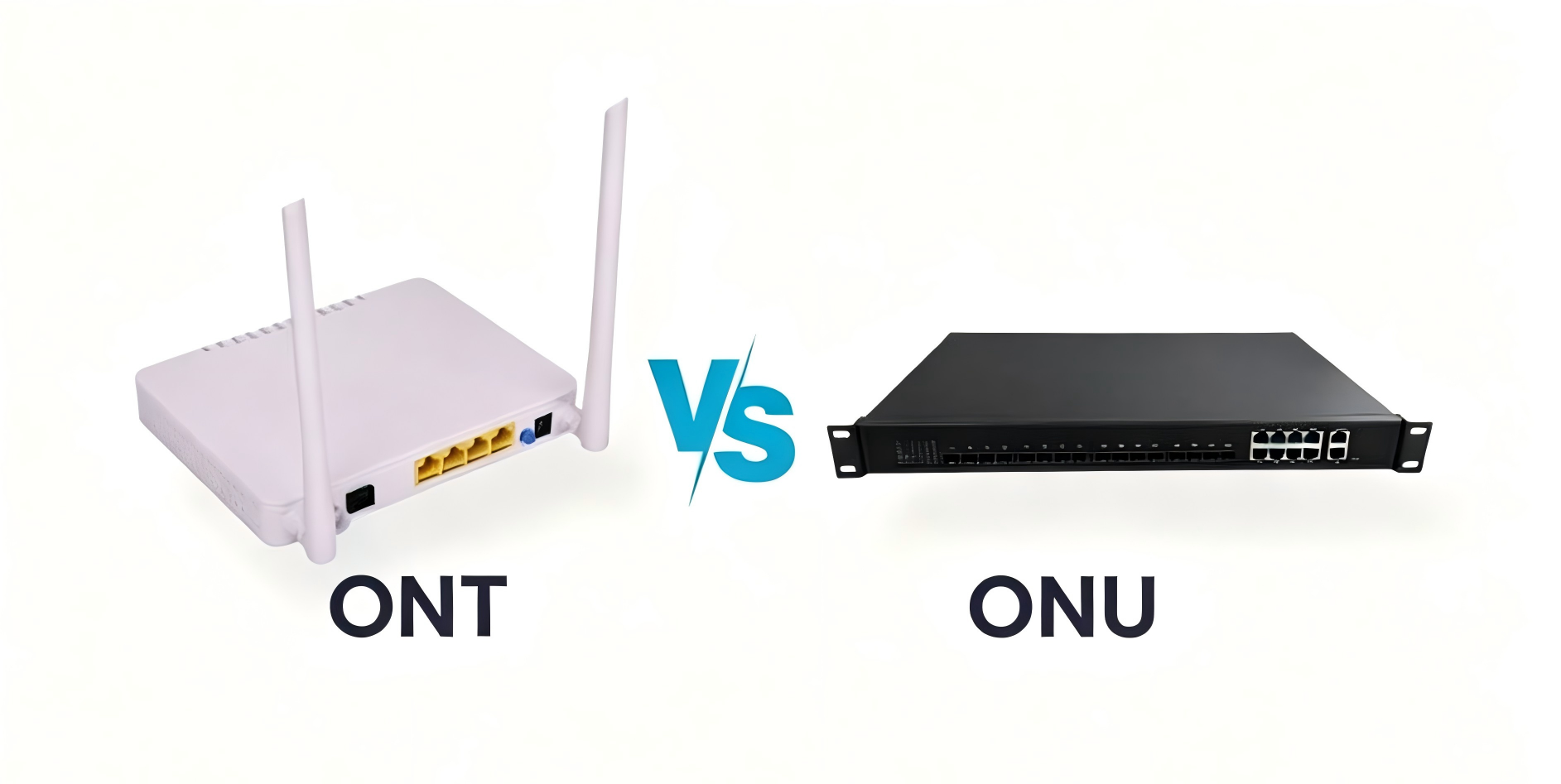
TERMINOLOGY NOTE The market commonly expands ONT as Optical Network Terminal. ITU-T Recommendations often use Optical Network Termination. Both expressions are encountered in product literature and generally refer to the subscriber-side terminal function discussed here. |
ONT and ONU are frequently treated as interchangeable terms, but the standards-based relationship is more specific. ITU-T G.984.1 describes an ONT as an ONU used for FTTH that includes the user-port function. ITU-T G.987 defines an ONT as an ONU supporting a single subscriber. In other words, ONU is the broader category, while an ONT is a particular subscriber-oriented ONU.
ONT and ONU comparison
Aspect | ONU | ONT |
Meaning | Optical Network Unit | Optical Network Terminal / Termination |
Scope | Generic leaf-side element that terminates the ODN and provides a user-side interface | A subscriber-oriented ONU; commonly associated with FTTH or one subscriber |
Deployment | May be used in FTTB, FTTC, MDU, enterprise, mobile, or residential access | Usually installed at or near a home, office, or individual subscriber premises |
Users served | Can serve one or multiple downstream users, depending on design | Typically serves one subscriber account or premises |
Market usage | Often used as a broad product term, including residential products | Often used by operators for customer-premises FTTH equipment |
Manufacturers and operators do not always apply the terminology consistently. A residential device may be sold as an ONU even when it performs the role commonly called an ONT. The label alone does not determine performance or compatibility; always check the PON standard, optical interface, management profile, service ports, and operator requirements.
ONT vs. OLT
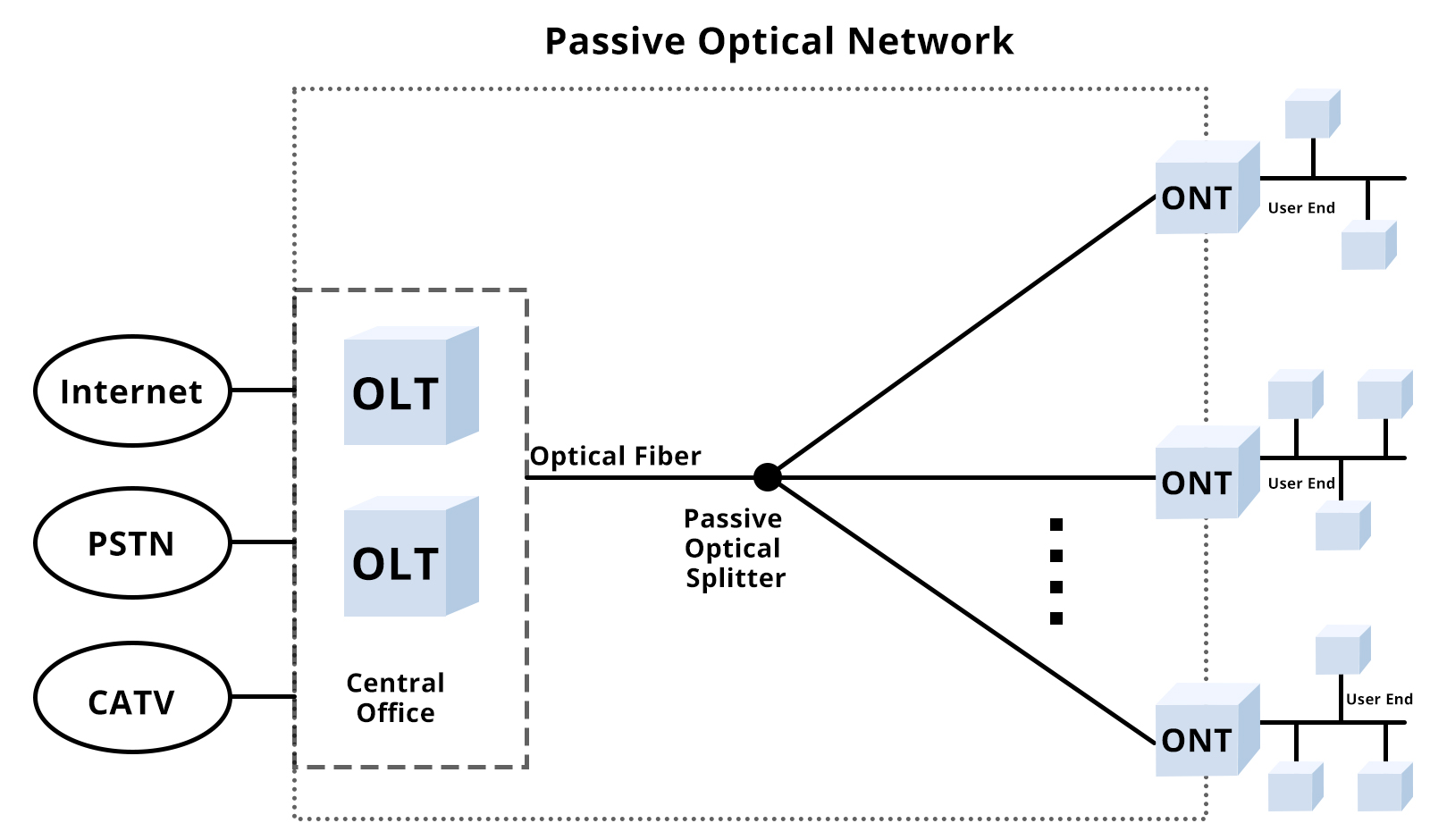
The OLT and ONT are located at opposite ends of the PON. The OLT is the provider-side controller and aggregation point, while the ONT is the subscriber-side endpoint.
OLT and ONT roles in a PON
Feature | OLT | ONT |
Location | Provider central office, headend, or access site | Customer premises or another subscriber-side location |
Network role | Controls and aggregates a PON | Terminates one leaf of the PON |
Relationship | One PON interface communicates with multiple ONTs/ONUs | One endpoint communicates with its serving OLT |
Primary interfaces | Uplinks toward the provider network and PON ports toward subscribers | PON port toward the OLT and user ports toward local equipment |
Management | Discovers, ranges, provisions, and monitors ONTs | Registers with the OLT and applies the provisioned service profile |
ONT vs. Modem vs. Router vs. Gateway
Calling an ONT a "fiber modem" can be a helpful analogy for homeowners because both devices connect an access network to local equipment. Technically, however, an ONT terminates a PON protocol rather than modulating and demodulating a cable or DSL signal in the same way as a conventional modem.
Common customer-premises network devices
Device | Main job | Typical network | Wi-Fi? |
ONT | Terminates the optical access link and presents subscriber interfaces | FTTH / PON | Only if integrated |
Cable or DSL modem | Terminates the cable or telephone-line access technology | DOCSIS cable or DSL | Only if integrated |
Router | Routes traffic between WAN and LAN; commonly provides NAT, DHCP, firewall, and Wi-Fi | Any broadband access | Often |
Gateway ONT | Combines ONT, router, and often voice/Wi-Fi functions | FTTH / PON | Usually |
A standalone bridge ONT normally connects to a separate router through Ethernet. An integrated home gateway unit can combine the ONT, routing, firewall, Wi-Fi, and voice functions in one enclosure. This is why the statement "an ONT never provides Wi-Fi" is too absolute: the answer depends on whether the product is a standalone ONT or an integrated gateway.
Common Types of ONTs
ONT classifications vary among vendors and operators, but the following categories are commonly encountered.
Bridge or SFU ONT: A relatively simple unit that presents one or more Ethernet and possibly voice ports. Routing is performed by separate customer equipment.
Home gateway unit (HGU): Combines the optical termination with routing, firewall, Wi-Fi, VoIP, and home-network management functions.
Business or SBU ONT: Designed for small-business services and may provide multiple Ethernet ports, voice interfaces, VLAN features, and enhanced management.
MDU ONU/ONT: Serves a multi-dwelling or multi-tenant location and may fan out service through Ethernet, telephone pairs, or other building distribution media.
Indoor or outdoor ONT: Selected according to mounting location, temperature range, moisture protection, power arrangement, and access for maintenance.
Which PON Standards Do ONTs Support?
An ONT must match the PON technology used by the OLT. GPON, XG-PON, and XGS-PON use different line rates and, in some cases, different wavelength bands. They are not automatically interchangeable simply because the connector fits.
Common ITU-T PON technologies
Technology | Nominal downstream | Nominal upstream | Common nominal wavelengths | Typical positioning |
GPON | 2.488 Gbit/s | 1.244 Gbit/s | 1490 nm down / 1310 nm up | Widely deployed residential and business access |
XG-PON1 | 9.953 Gbit/s | 2.488 Gbit/s | 1577 nm down / 1270 nm up | Asymmetric 10G-class access |
XGS-PON | 9.953 Gbit/s | 9.953 Gbit/s | 1577 nm down / 1270 nm up | Symmetric 10G-class access |
These are nominal shared PON line rates, not guaranteed Internet throughput for every subscriber. Actual service speed depends on the operator profile, split ratio, network load, protocol overhead, ONT user-port speed, router capability, and local network conditions.
How to Select a Compatible ONT
An ONT is usually supplied or approved by the Internet service provider. Unlike an unmanaged media converter, it is not generally a universal plug-and-play device. Check the following factors before specifying or replacing one.
PON technology. Confirm whether the network uses GPON, XG-PON, XGS-PON, EPON, 10G-EPON, or another access system. Matching the fiber connector is not enough.
OLT interoperability and provisioning. Verify the supported OLT platform, OMCI profile, serial-number format, LOID or password method, software version, and operator authorization process.
Optical budget and ODN design. Match the required optical class and receive/transmit ranges to total loss from fiber, splitters, connectors, splices, and design margin.
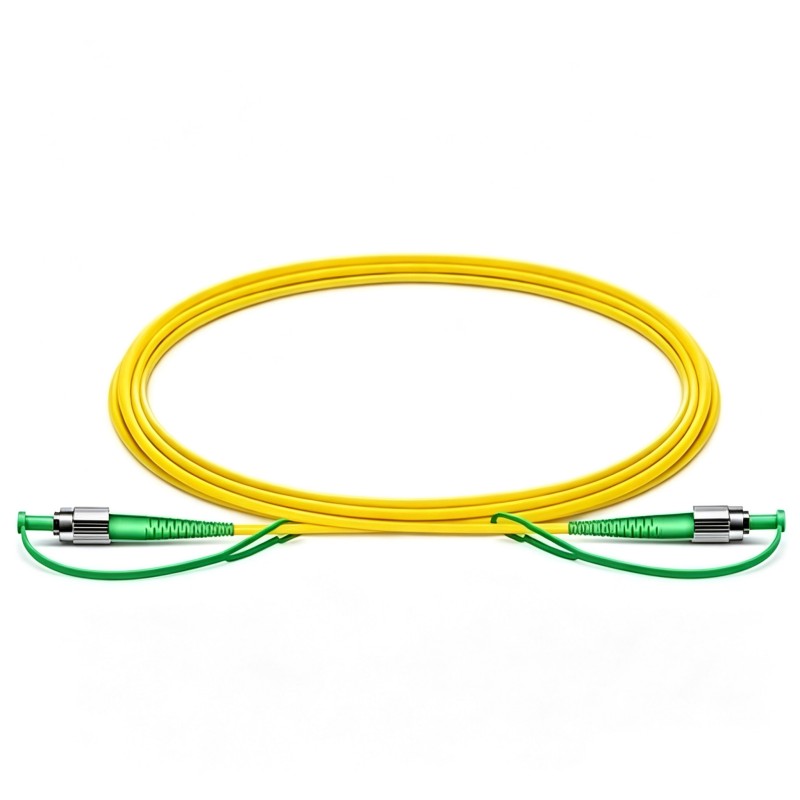
PON connector and polish. SC/APC is common in access networks because of its return-loss performance. Do not mate APC and UPC connectors; their end-face geometries are different and can cause high loss or damage.
Subscriber interfaces. Select the number and speed of Ethernet ports, voice ports, Wi-Fi generation, RF-video support, and any required business interfaces. A 1GbE LAN port can bottleneck a multi-gigabit service.
Bridge or gateway mode. Decide whether routing, NAT, firewall, Wi-Fi, and voice should be integrated or handled by separate equipment.
Installation environment and power. Check indoor/outdoor rating, temperature, enclosure, power adapter, battery-backup requirements, mounting, and grounding instructions.
Lifecycle and security. Consider firmware support, remote management, vulnerability response, configuration backup, and operator replacement policy.
ONT Installation and Fiber Handling
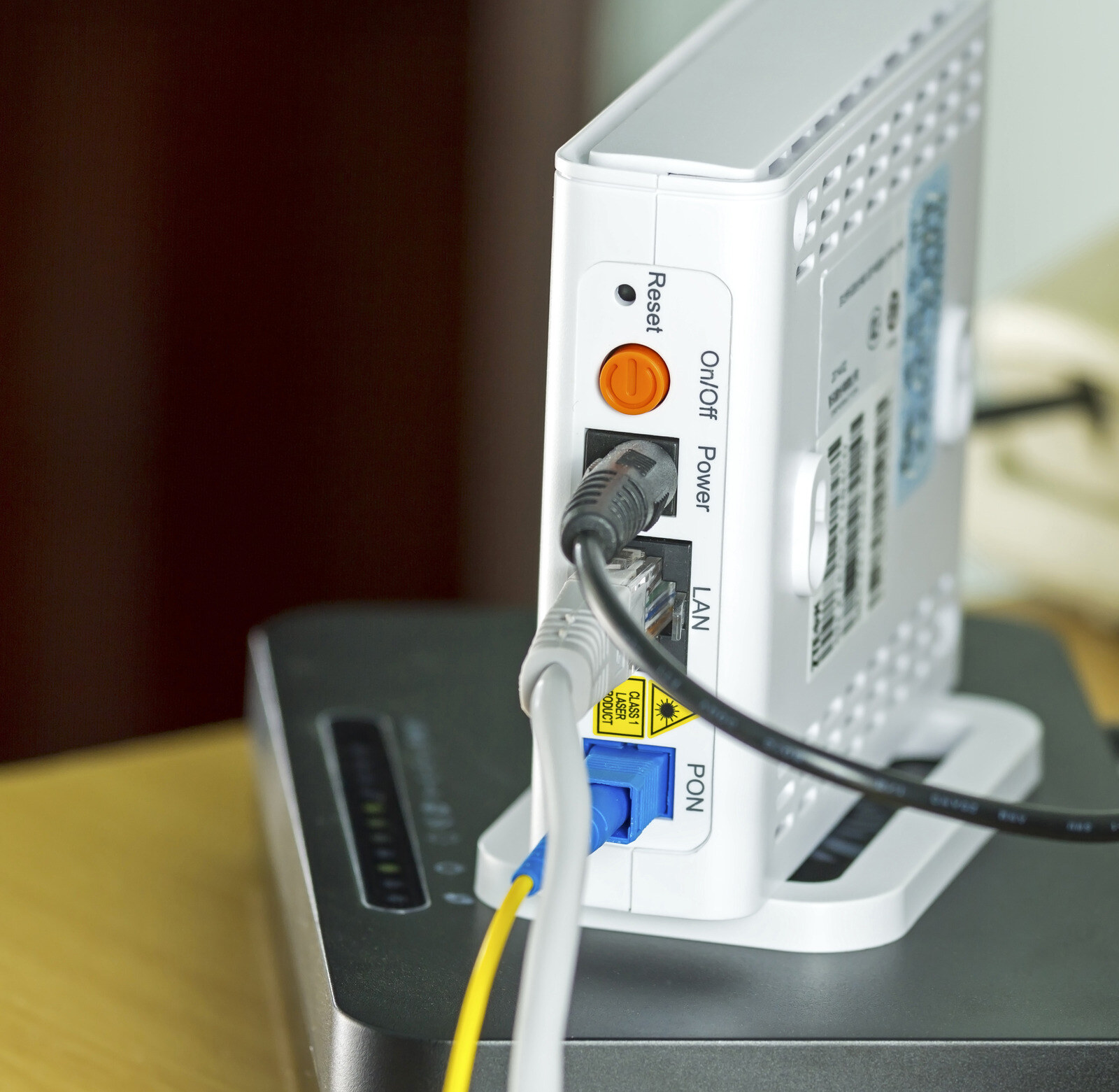
Service providers normally install and provision the ONT because the device must be associated with the correct OLT port and subscriber account. The optical link should also be tested against the network's loss budget.
Keep connectors clean. A small amount of dust or oil on the ferrule can cause significant loss and reflection. Leave protective caps in place until connection and use approved inspection and cleaning procedures.
Respect bend limits. Do not sharply bend, pinch, staple, or crush the drop cable. Excessive bending can increase attenuation or permanently damage the fiber.
Do not look into a fiber connector. The optical signal may be invisible. Follow the operator's laser-safety procedure and use appropriate test equipment.
Provide stable power and ventilation. An ONT is active equipment. Poor power, heat buildup, or an unsuitable enclosure can cause intermittent faults.
Avoid unapproved resets. A factory reset may remove service configuration. Follow the provider's instructions before resetting or replacing the unit.
What Do the ONT Indicator Lights Mean?
LED labels and behaviors vary by manufacturer, but the following patterns are common.
Typical ONT indicators and first checks
Indicator | Possible meaning | Useful first check |
Power | Off usually indicates no power; abnormal blinking may indicate startup or a fault | Check the approved power adapter, outlet, and battery backup |
PON / Optical | Solid often means registered; blinking may mean discovery, registration, or traffic | Allow startup to finish; contact the provider if registration never completes |
LOS / Alarm | Red or blinking commonly indicates low or missing optical signal | Check for a loose connector, damaged cable, or severe bend without opening sealed provider equipment |
LAN / Ethernet | Shows link state and often traffic activity | Check the Ethernet cable, router WAN port, port speed, and link LEDs |
Voice / TEL | Shows voice-service registration or call status | Check service provisioning and telephone wiring |
A normal optical light with no Internet access may point to router configuration, account provisioning, DNS, VLAN, Ethernet, or service-provider issues rather than a failed fiber link. A persistent LOS alarm, by contrast, usually requires optical-path troubleshooting by the provider or a qualified technician.
Frequently Asked Questions
Is an ONT the same as a router?
No. A standalone ONT terminates the fiber access link, while a router directs traffic between the Internet connection and the local network. Some gateway ONTs integrate both functions in one device.
Do I need a modem if I have an ONT?
An FTTH connection normally does not require a separate cable or DSL modem. The ONT performs the access-termination role for the fiber service. You may still need a separate router if routing and Wi-Fi are not integrated.
Does an ONT provide Wi-Fi?
A bridge ONT usually does not. An HGU or gateway ONT may include a router and Wi-Fi access point. Check the product specification rather than relying on the ONT label alone.
Can I buy and install my own ONT?
Sometimes, but only when the provider permits it and confirms compatibility. The device normally must match the PON standard, OLT, management profile, firmware, and registration method, and it must be provisioned on the network.
Does an ONT require electrical power?
Yes. The distribution network may be passive, but the ONT contains optical, digital, and interface electronics. During a power outage, Internet and voice services normally stop unless the ONT and associated router have backup power.
Can an ONT limit Internet speed?
Yes. The PON generation, service profile, Ethernet-port speed, processing capacity, and integrated Wi-Fi can all become bottlenecks. For example, a 1GbE user port cannot deliver more than gigabit-class Ethernet throughput even when the PON side supports a higher rate.
Is an ONT better than an ONU?
Not inherently. ONT and ONU describe device scope or deployment terminology, not a performance ranking. Compare standards, optical class, ports, management compatibility, reliability, and service features instead.
Where is an ONT normally installed?
It may be mounted on an interior wall, in a structured wiring cabinet, utility room, garage, telecom room, or weather-rated outdoor enclosure. The location depends on the drop-cable route, power availability, environment, and provider practice.
Conclusion
An ONT is the active subscriber-side endpoint that turns a shared optical access network into usable services at a home, office, or other premises. It receives downstream traffic, transmits upstream bursts under OLT control, terminates the PON protocol, supports provisioning and monitoring, and presents interfaces for local equipment.
The most important terminology point is that an ONT is not normally a second device installed after an ONU. In standards-based usage, it is a subscriber-oriented type of ONU, although manufacturers and operators often use the two names interchangeably.
Reliable ONT performance also depends on the complete ODN: properly selected fiber cable, low-loss splitters, clean and correctly polished connectors, sound splicing, suitable adapters, and an optical power budget with adequate engineering margin.
FIRSOL SUPPORT Firsol supplies fiber-optic connectivity and passive optical components for access-network deployment, including optical splitters, fiber cables, patch cords, adapters, and custom solutions. For help with connector, cable, splitter, wavelength, or loss-budget requirements, contact [email protected]. |