A Comprehensive Guide to Variable Optical Attenuators (VOA): Types, Selection, and Best Practices
In the world of fiber optics, managing optical power is just as critical as transmitting data. Whether you are protecting a sensitive receiver from saturation or balancing signal levels in a complex network, the Variable Optical Attenuator (VOA) is an indispensable tool.
However, with various mechanical and electronic designs available, choosing the right VOA can be challenging. In this guide, we will break down the primary types of VOAs and provide a factual framework for selection.
What is a Variable Optical Attenuator (VOA)?
A VOA is a passive or active component used to reduce the power level of an optical signal. Unlike fixed attenuators (which have a set value like 5dB or 10dB), a VOA allows for continuous or incremental adjustment of attenuation, typically ranging from 1dB to 30dB or even 60dB.
The Three Main Types of VOAs
1. In-line Manual VOA (The "Workhorse")
The In-line Manual VOA is the most common choice for laboratory R&D and system integration.
Design: It features fiber pigtails (typically 1 meter) on both ends and a central housing with a mechanical adjustment screw.
Key Advantage: It is a passive mechanical device, meaning it requires no external power. It is robust, offers high stability, and is often used in visible light applications (such as 1550nm SM VOA) where precision is paramount.
Best For: Permanent splicing into a system's internal optical path or benchtop testing.
2. Adapter Type VOA (The "Bridge")
If you need to adjust power on a patch panel or ODF, the Adapter Type VOA is the most efficient solution.
Design: This is a pigtail-free, female-to-female design. It acts as a functional "bridge" between two existing patch cords.
Key Advantage: It saves space and eliminates the need for extra splicing. By simply rotating the threaded metal housing, you can tune the attenuation level.
Best For: Network maintenance, field engineering, and quick power adjustments between patch cords.
3. MEMS Electronic VOA (The "Automation Expert")
For high-speed, automated networks, the MEMS (Micro-Electro-Mechanical Systems) VOA is the professional standard.
Design: An electronic component that uses a tiny internal mirror controlled by voltage to adjust light coupling.
Key Advantage: Fast response time (milliseconds) and small footprint. It allows for remote, software-controlled power balancing.
Best For: EDFA (Erbium-Doped Fiber Amplifiers), dynamic gain equalization, and telecommunication modules.
Technical Focus: The "APC vs. UPC" Compatibility Rule
A common point of confusion is the connection between different end-face polishes. When using an Adapter Type VOA, you must match the connector types strictly:
FC/APC to FC/APC: Essential for high-power laser systems. The 8° angled polish ensures a High Return Loss (≥60dB), protecting your source from reflections.
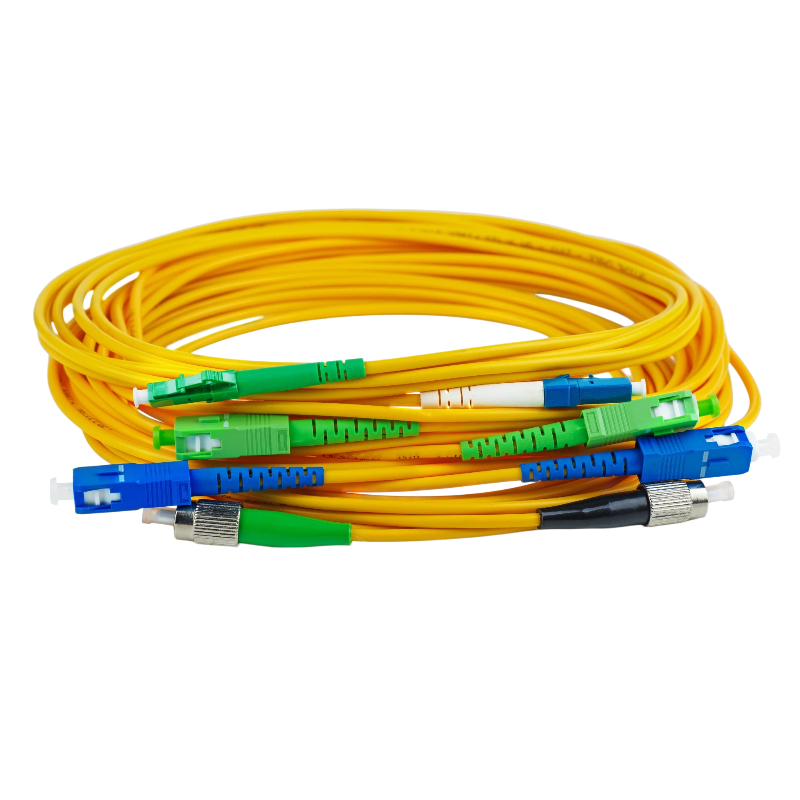
The Golden Rule: Never connect an FC/UPC (Blue/Black) plug into an FC/APC (Green) VOA. This mismatch creates an air gap, leading to high insertion loss, signal instability, and potential physical damage to the fiber cores.
Selection Checklist: Which VOA Do You Need?
Feature | In-line Manual | Adapter Type | MEMS (Electronic) |
|---|---|---|---|
Power Required | No (Passive) | No (Passive) | Yes (Voltage) |
Attenuation Range | 0 ~ 60dB | 0 ~ 30dB | 0 ~ 40dB |
Pigtails | Yes (Typically 1m) | No (Plug-and-play) | Yes (Short leads) |
Adjustment | Manual Screw | Rotating Housing | Electronic/Software |
Primary Use | System Integration | Maintenance/Patch Panels | EDFA/Automation |
Conclusion
Selecting the right VOA is not just about the attenuation range; it’s about understanding your installation environment and optical budget.
For a robust, "set-and-forget" manual solution, the In-line VOA is king.
For flexibility on a crowded rack, go with the Adapter Type.
For modern, automated optical systems, the MEMS VOA is the clear winner.