What Is an SC Fiber Adapter? Types, Features, and Applications
SC fiber adapters are widely used in fiber optic networks to connect two SC fiber connectors with accurate fiber alignment. They are simple, reliable, and suitable for a wide range of optical communication systems, including telecom networks, data centers, LANs, CATV systems, and fiber distribution frames.
This article explains what an SC fiber adapter is, how it works, the common types available, and how to choose the right SC adapter for your fiber optic application.
What Is an SC Fiber Adapter?
An SC fiber adapter, also called an SC coupler or SC to SC adapter, is a passive fiber optic component used to connect two SC fiber optic connectors. Its main function is to align the ferrules of two SC connectors precisely so that optical signals can pass from one fiber to another with low insertion loss.
SC adapters are commonly mounted in fiber patch panels, optical distribution frames, fiber terminal boxes, wall plates, and network equipment panels. They provide a stable connection point between two SC-terminated fiber optic patch cables or pigtails.
SC is commonly understood as Subscriber Connector, Standard Connector, or Square Connector. In practical fiber optic applications, the term usually refers to the push-pull connector interface with a 2.5 mm ferrule.
How Does an SC Fiber Adapter Work?
An SC fiber adapter does not actively process, amplify, or convert optical signals. Instead, it provides mechanical alignment between two SC connectors.
Inside the adapter, a precision alignment sleeve holds the ferrules of the two connectors in position. When the connectors are inserted from both sides, the fiber cores are aligned face to face. This allows light to pass through the connection point with minimal optical loss.
The alignment sleeve is usually made of ceramic for high-precision single mode or multimode applications, although some cost-sensitive adapters may use metal or phosphor bronze sleeves.
Key Features of SC Fiber Adapters
SC fiber adapters are popular because they offer a good balance of performance, cost, and ease of use.
Feature | Description |
|---|---|
Interface Type | SC to SC fiber optic connection |
Connector Mechanism | Push-pull design for easy insertion and removal |
Ferrule Size | Compatible with 2.5 mm SC connector ferrules |
Structure Options | Simplex, duplex, with flange, or without flange |
Fiber Compatibility | Single mode OS2 and multimode OM1, OM2, OM3, OM4 |
Polish Compatibility | UPC or APC, depending on connector type |
Typical Applications | ODF, patch panels, terminal boxes, LAN, CATV, telecom networks |
Common Types of SC Fiber Adapters
SC fiber adapters are available in different configurations depending on fiber type, polish type, structure, and installation method.
1. Single Mode SC Fiber Adapter
Single mode SC adapters are designed for OS2 single mode fiber optic systems. They are typically used in long-distance transmission, telecom networks, FTTH systems, and high-performance optical links.
Common single mode SC adapter types include:
SC/UPC to SC/UPC adapter
SC/APC to SC/APC adapter
Simplex SC adapter
Duplex SC adapter
SC adapter with flange
SC adapter without flange
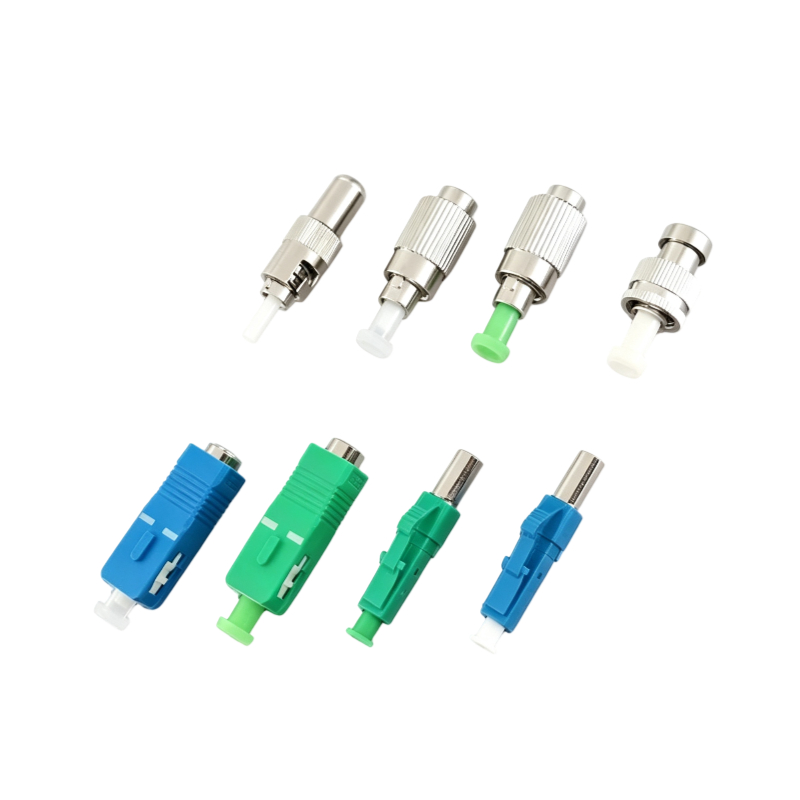
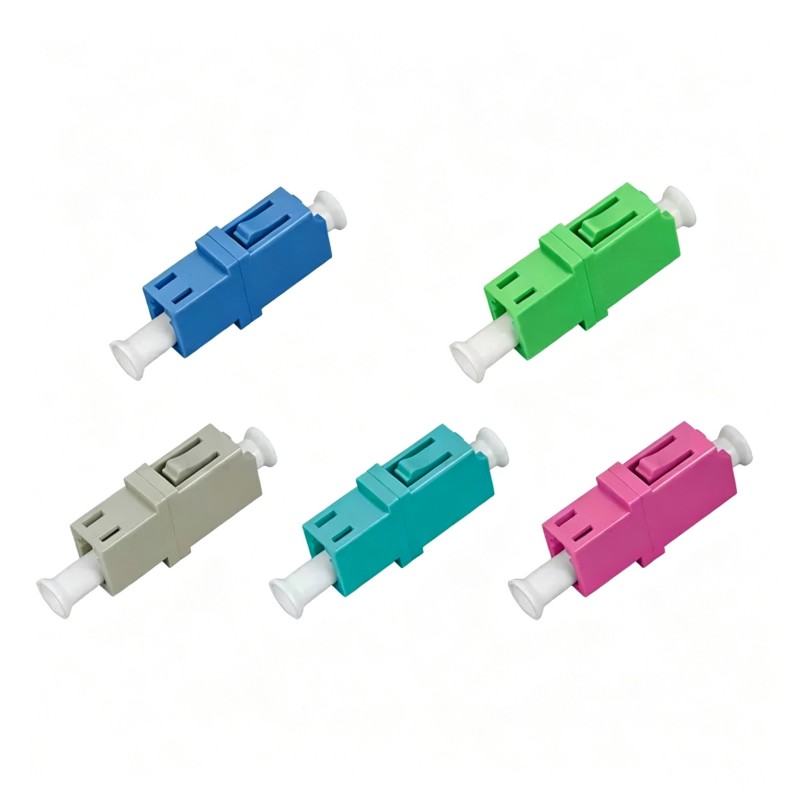
Single mode SC/UPC adapters are commonly blue, while SC/APC adapters are commonly green. UPC and APC connectors should not be mixed because their end-face angles are different.
2. Multimode SC Fiber Adapter
Multimode SC adapters are used with multimode fiber systems such as OM1, OM2, OM3, and OM4. They are commonly used in short-distance data transmission, enterprise networks, LANs, and data center interconnections.
Typical multimode SC adapters include:
OM1 SC/UPC adapter
OM2 SC/UPC adapter
OM3 SC/UPC adapter
OM4 SC/UPC adapter
Multimode SC adapters are usually designed for UPC connectors. Beige is commonly used for OM1/OM2, while aqua or violet may be used for OM3/OM4 depending on the system design and manufacturer.
3. Simplex SC Adapter
A simplex SC adapter connects one fiber channel. It has one SC port on each side and is used when a single fiber connection is required.
Simplex SC adapters are common in fiber terminal boxes, wall outlets, test setups, and single-channel optical links.
4. Duplex SC Adapter
A duplex SC adapter connects two fiber channels side by side. It is often used for transmit and receive fiber pairs in Ethernet, telecom, and data communication systems.
Duplex SC adapters help organize paired fiber connections and are commonly installed in fiber patch panels and optical distribution frames.
5. SC Adapter With Flange
An SC adapter with flange includes mounting ears or screw holes for panel installation. The flange helps secure the adapter firmly to a patch panel, terminal box, or equipment panel.
This type is suitable for fixed installations where mechanical stability is important.
6. SC Adapter Without Flange
An SC adapter without flange has a more compact structure and is usually installed using snap-in mounting. It is suitable for high-density panels or applications where space is limited.
SC/UPC vs SC/APC Adapter
SC adapters must match the polish type of the connectors being used.
SC/UPC Adapter
SC/UPC adapters are designed for SC/UPC connectors. UPC stands for Ultra Physical Contact. These connectors have a flat or slightly curved end face and are widely used in general fiber optic networks.
SC/UPC adapters are typically blue in single mode applications.
SC/APC Adapter
SC/APC adapters are designed for SC/APC connectors. APC stands for Angled Physical Contact. The connector end face is polished at an angle, typically 8 degrees, to reduce back reflection.
SC/APC adapters are commonly green and are widely used in FTTH, CATV, passive optical networks, and applications where return loss performance is important.
Can SC/UPC and SC/APC Be Connected Together?
No. SC/UPC and SC/APC connectors should not be connected together. Their end-face geometry is different, and mixing them can cause high insertion loss, poor return loss, and possible connector damage.
SC Adapter vs SC Connector
Although the terms are related, an SC adapter and an SC connector are not the same component.
An SC connector is installed at the end of a fiber optic cable or pigtail. It is the plug that carries the fiber ferrule.
An SC adapter is the coupling component used to connect two SC connectors. It is usually installed in a panel, enclosure, or device and provides accurate alignment between the two connectors.
In simple terms, the connector is the plug, and the adapter is the socket or coupler that joins two plugs together.
Typical Applications of SC Fiber Adapters
SC fiber adapters are used in many fiber optic network environments, including:
Optical distribution frames
Fiber patch panels
Fiber terminal boxes
FTTH and FTTx networks
CATV systems
LAN and enterprise networks
Data center fiber cabling
Telecom equipment rooms
Test and measurement setups
Fiber optic wall plates and enclosures
Because of their push-pull structure and stable performance, SC adapters remain one of the most widely used fiber interconnection components in optical communication systems.
How to Choose the Right SC Fiber Adapter
When selecting an SC fiber adapter, consider the following factors:
1. Fiber Type
Choose a single mode SC adapter for OS2 single mode fiber systems. Choose a multimode SC adapter for OM1, OM2, OM3, or OM4 multimode fiber systems.
2. Polish Type
Use SC/UPC adapters with SC/UPC connectors and SC/APC adapters with SC/APC connectors. Do not mix UPC and APC interfaces.
3. Simplex or Duplex Structure
Choose a simplex adapter for one fiber connection. Choose a duplex adapter when you need a paired transmit and receive connection.
4. Flanged or Flangeless Design
Use a flanged SC adapter when the adapter needs to be firmly fixed to a panel with screws. Use a flangeless SC adapter for compact snap-in installations.
5. Sleeve Material
For high-performance single mode networks, ceramic sleeves are preferred because they provide better alignment precision and long-term stability.
Firsol SC Fiber Adapter Options
Firsol provides a range of SC fiber adapters for single mode and multimode fiber optic networks. Available options include OS2 single mode SC/UPC and SC/APC adapters, as well as OM1, OM2, OM3, and OM4 multimode SC/UPC adapters.
Common configurations include:
OS2 Single Mode Simplex SC/UPC to SC/UPC Fiber Adapter
OS2 Single Mode Simplex SC/APC to SC/APC Fiber Adapter
OS2 Single Mode Duplex SC/UPC to SC/UPC Fiber Adapter
OS2 Single Mode Duplex SC/APC to SC/APC Fiber Adapter
OM1/OM2/OM3/OM4 Multimode SC/UPC Fiber Adapter
SC Fiber Adapter With Flange
SC Fiber Adapter Without Flange
These adapters are suitable for fiber patch panels, ODF systems, fiber terminal boxes, telecom networks, enterprise cabling, and data center fiber connections.
FAQ About SC Fiber Adapters
What is an SC fiber adapter used for?
An SC fiber adapter is used to connect two SC fiber optic connectors. It aligns the fiber ferrules inside the connectors so that optical signals can pass through the connection with low loss.
Is an SC adapter the same as an SC coupler?
Yes. In many fiber optic applications, SC adapter and SC coupler refer to the same component. Both terms describe a passive device used to connect two SC connectors.
What is the difference between SC/UPC and SC/APC adapters?
SC/UPC adapters are used with UPC polished connectors, while SC/APC adapters are used with angled APC polished connectors. SC/UPC adapters are typically blue, and SC/APC adapters are typically green in single mode systems.
Can I use a single mode SC adapter for multimode fiber?
It is not recommended. Single mode and multimode systems have different fiber types and application requirements. For stable performance, the adapter should match the fiber and connector type used in the network.
What is the difference between simplex and duplex SC adapters?
A simplex SC adapter connects one fiber channel, while a duplex SC adapter connects two fiber channels side by side. Duplex adapters are commonly used for transmit and receive fiber pairs.
Where are SC adapters commonly installed?
SC adapters are commonly installed in optical distribution frames, patch panels, fiber terminal boxes, wall plates, data center cabinets, and telecom equipment panels.
Conclusion
An SC fiber adapter is a simple but important component in fiber optic networks. It provides precise mechanical alignment between two SC connectors and helps maintain stable optical transmission with low insertion loss.
When choosing an SC adapter, it is important to match the fiber type, polish type, structure, and mounting style with your network requirements. For single mode, multimode, simplex, duplex, flanged, or flangeless SC adapter options, Firsol provides reliable solutions for telecom, data center, FTTH, CATV, and enterprise fiber optic applications.