Polarization Insensitive Optical Isolator: How It Works, PI vs PM Differences, and How to Choose
In fiber optic systems, back reflections can significantly degrade performance and even damage sensitive laser sources. Optical isolators are designed to prevent this by allowing light to pass in only one direction.
Among different types, the Polarization Insensitive (PI) Optical Isolator is widely used because it operates reliably regardless of the input polarization state. This makes it ideal for real-world fiber systems where polarization is often unpredictable.
In this guide, we’ll explain how PI isolators work, how they differ from polarization maintaining (PM) isolators, and how to choose the right one for your application.
How Does a Polarization Insensitive Optical Isolator Work?
A polarization insensitive optical isolator is based on the Faraday effect, a non-reciprocal optical phenomenon.
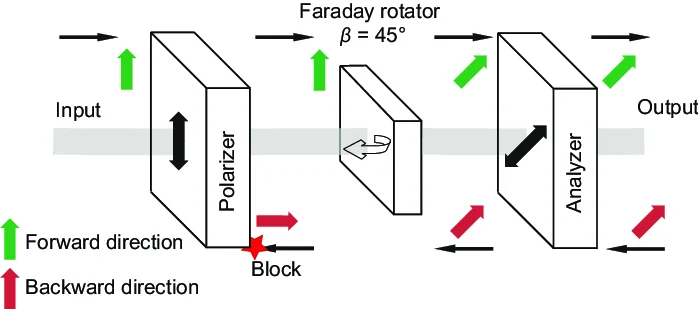
The internal structure typically includes:
Polarizers
Magneto-optic crystal
Working principle:
Forward light: polarization is rotated and aligned → passes through
Backward light: polarization becomes misaligned → blocked
Unlike standard polarization-dependent devices, a PI isolator is designed to handle random polarization states, ensuring stable transmission without requiring polarization control.
PI vs PM Optical Isolator: What’s the Difference?
Choosing between PI and PM isolators is one of the most common questions.
Type | Key Feature | Typical Use |
|---|---|---|
Polarization Insensitive (PI) Isolator | Works with random polarization | Fiber communication systems |
Polarization Maintaining (PM) Isolator | Maintains fixed polarization axis | Laser systems |
Key takeaway:
Use PI isolators for standard single mode fiber systems
Use PM isolators when polarization alignment is critical
Single Stage vs Dual Stage Isolator
Another key design choice is the number of stages.
Single Stage
Lower insertion loss
Suitable for general applications
Dual Stage
Higher isolation (up to ~55 dB)
Better for sensitive or high-power systems
Higher isolation requires more stages, which slightly increases insertion loss.
This is a practical trade-off between isolation performance and signal attenuation.
How to Choose the Right Optical Isolator
1. Select the Wavelength
1310 nm / 1550 nm → Telecom & DWDM systems
1480 nm → EDFA pump systems
1064 nm → Fiber and solid-state lasers
2. Determine Required Isolation
30–40 dB → Standard protection
45–55 dB → High-performance or sensitive systems
3. Choose Power Handling
Low power (<0.5 W) → General applications
High power (1–5 W) → Laser systems or amplifiers
4. Consider System Requirements
Need low loss → choose single stage
Need strong protection → choose dual stage
Applications of Polarization Insensitive Optical Isolators
PI isolators are widely used in:
Optical communication systems (DWDM / CWDM)
EDFA and optical amplifiers
Fiber laser systems
Optical test and measurement setups
Optical sensing systems
They play a critical role in improving system stability, reducing noise, and protecting optical components.
Why Polarization Insensitive Isolators Are Preferred
Compared to polarization-dependent solutions, PI isolators offer:
Stable performance without polarization control
Easier system integration
Higher reliability in real-world environments
This is why they are the default choice in most telecom and general optical systems.
Conclusion
Polarization insensitive optical isolators are essential components for ensuring stable and reliable operation in fiber optic systems. By effectively blocking back reflections and working independently of polarization state, they provide a practical and robust solution for a wide range of applications.
Understanding how they work and how to choose the right configuration—wavelength, isolation level, and power handling—can significantly improve system performance.