3 Port Optical Circulator: Working Principle, Types (Single Mode vs PM), and How to Choose
In modern fiber optic communication systems, controlling the direction of light with minimal loss is critical. Whether in DWDM transmission, fiber lasers, optical amplifiers, or sensing systems, one component frequently plays a key role: the 3 Ports Optical Circulator.
Unlike standard couplers or splitters, an optical circulator is a non-reciprocal passive device that routes light in only one direction. This unique function makes it essential for isolating signals, reducing back reflections, and enabling advanced optical system architectures.
In this guide, we’ll explain how a 3-port optical circulator works, the differences between Single Mode and Polarization Maintaining (PM) versions, and how to choose the right model for your application.
What Is a 3 Port Optical Circulator?
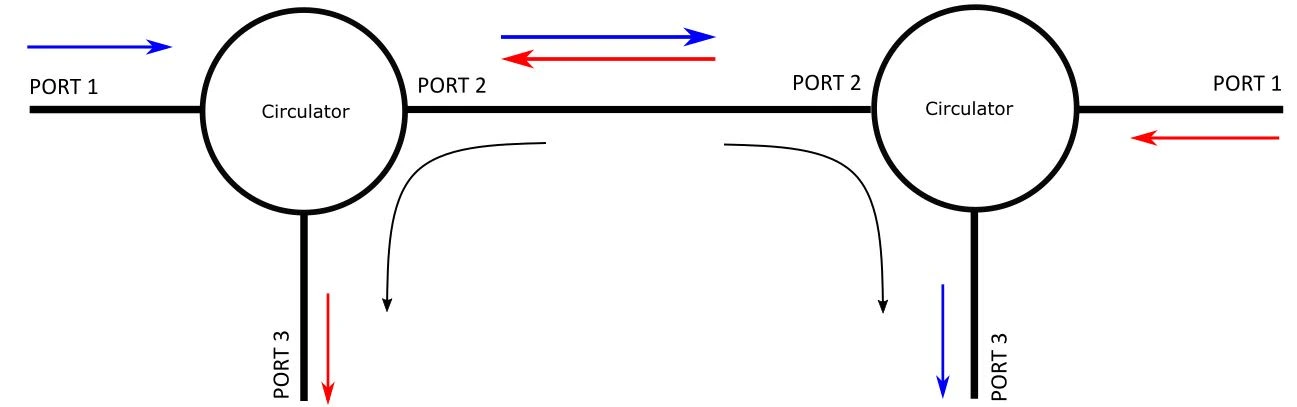
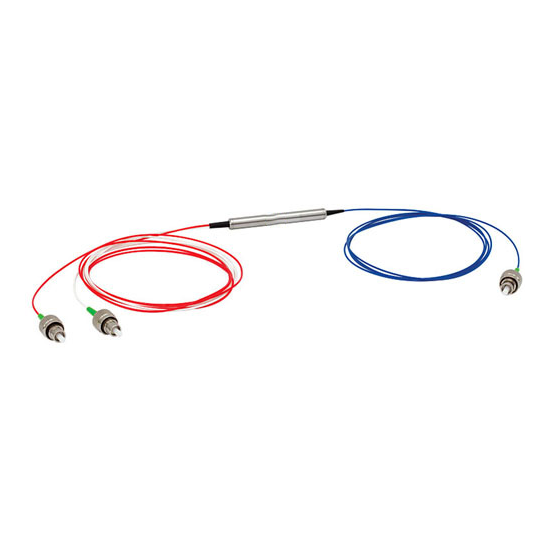
A 3 Port Optical Circulator is a passive, non-reciprocal optical device that routes light sequentially between three ports in a fixed direction:
Port 1 → Port 2
Port 2 → Port 3
Port 3 → Port 1
This one-way transmission mechanism allows optical signals to be directed without back reflection, making circulators essential in modern fiber optic systems.
Unlike optical splitters, circulators do not divide optical power—they redirect it with high isolation and low insertion loss.
How Does an Optical Circulator Work?
Optical circulators are based on magneto-optic effects, typically using:
Faraday rotators
Polarization beam splitters (PBS)
Magneto-optic crystals
Unlike an optical isolator (which blocks reverse light), a circulator redirects backward light to another port instead of absorbing it.
This is why circulators are widely used in:
Bidirectional transmission
Fiber Bragg Grating (FBG) systems
Optical amplifiers
Laser systems
Types of Optical Circulators
1. Single Mode Optical Circulator (PI – Polarization Independent)
Fiber: SMF-28
Low PDL (≤0.15 dB typical)
Wavelength: 1310 / 1550 / C+L
Best for:
DWDM systems
EDFA amplifiers
Telecom networks
OTDR testing
2. Polarization Maintaining (PM) Optical Circulator
Fiber: PM980 / PM1300 / PM1550
High extinction ratio (≥20 dB)
Controlled polarization axis
Best for:
Fiber laser systems
Interferometers
Coherent communication
Optical sensing
Single Mode vs PM Circulator (Key Differences)
Feature | Single Mode (PI) | PM Circulator |
|---|---|---|
Fiber Type | SMF-28 | PM Fiber |
Polarization | Random | Maintained |
Cost | Lower | Higher |
Application | Telecom | Laser / Precision |
Key Parameter | PDL | Extinction Ratio |
Rule of thumb:
If polarization matters → choose PM
If not → choose Single Mode
Key Specifications Explained
Insertion Loss (IL)
Typical: ≤ 0.8–0.9 dB
Lower = better efficiency
Isolation
Typical: ≥ 40 dB
High-end: up to 50 dB
Prevents signal interference and reflections
Return Loss (RL)
Typical: ≥ 50 dB
Important for laser stability
Extinction Ratio (PM only)
Typical: ≥ 20 dB
Measures polarization quality
Optical Power Handling
0.5W (standard telecom)
1W / 2W (advanced systems)
5W (high-power laser systems)
Real Applications of Optical Circulators
1. DWDM Systems (FBG Filtering)
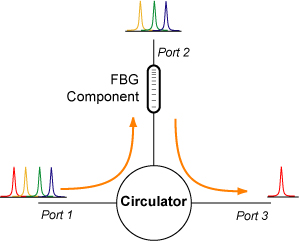
A circulator combined with a Fiber Bragg Grating (FBG) can drop or add specific wavelengths:
Port 1 → signal input
Port 2 → FBG reflection
Port 3 → filtered output
Widely used in wavelength management
2. Optical Amplifiers (EDFA)
Circulators:
Direct signal into amplifier
Separate amplified output
Suppress back reflections
3. Fiber Laser Systems
PM circulators are critical for:
Maintaining polarization
Preventing feedback
Improving beam quality
4. Fiber Optic Sensors
Used in:
Temperature sensing
Strain monitoring
Interferometric systems
High isolation ensures accurate measurement
Common Mistakes When Choosing a Circulator
Mistake 1: Using PM when not needed
PM Optical Circulator is more expensive and unnecessary for standard telecom systems.
Mistake 2: Ignoring axis alignment (PM only)
PM fiber requires:
Slow axis aligned with connector key
Misalignment = performance failure.
Mistake 3: Underestimating connector impact
Adding connectors will:
Increase IL by ~0.3 dB
Reduce RL by ~5 dB
This is normal and should be expected.
Mistake 4: Choosing based only on price
Low-cost circulators often have:
Unstable isolation
Poor long-term reliability
Weak high-power performance
How to Choose the Right Optical Circulator
When selecting a circulator, consider:
1. Wavelength
1064 nm → laser
1310 / 1550 nm → telecom
C+L band → DWDM
2. Fiber Type
SMF → general use
PM → polarization-sensitive
3. Power Requirement
≤0.5W → telecom
≥1W → laser / high power
4. Application Scenario
FBG → need high isolation
Laser → need PM
DWDM → need broadband
Firsol Optical Circulator Solutions
Firsol provides a full range of optical circulators:
Single Mode (PI) & PM versions
Wavelengths: 1064 / 1310 / 1550 / C+L / S+C+L
Power options: up to 5W
Custom fiber length, connectors, and axis alignment
All products are designed for:
Low insertion loss
High isolation
Long-term stability
Final Thoughts
A 3 Port Optical Circulator is not just a passive component—it is a critical building block in modern optical systems.
Choosing the right circulator can significantly improve:
Signal quality
System stability
Measurement accuracy
Laser performance
Whether you are designing a telecom network, fiber laser, or sensing system, selecting the correct circulator from the beginning will save both time and cost.