Why Do Some FC/APC Fiber Adapters Cost More? Seikoh Giken SNA-1 and Wide Key vs. Narrow Key Explained
Two FC/APC fiber adapters can look nearly identical. Both have an FC/APC female interface on each side, both may use a metal housing and zirconia ceramic alignment sleeve, and both perform the same basic function: connecting two FC/APC fiber connectors.
However, their prices can differ significantly.
Why would a laboratory, equipment manufacturer, or optical component producer pay more for a branded precision adapter such as the Seikoh Giken SNA-1 instead of using a standard FC/APC adapter? Why is the SNA-1 offered in separate Wide Key and Narrow Key versions, while many generic FC/APC adapters do not even mention key type?
The answer involves more than brand recognition. Alignment precision, angular positioning, connection repeatability, mechanical tolerances, documentation, and batch consistency can all affect the value of an FC/APC adapter.
This guide explains these differences and helps you determine when a precision adapter is worth the additional cost.
What Does an FC/APC Fiber Adapter Do?
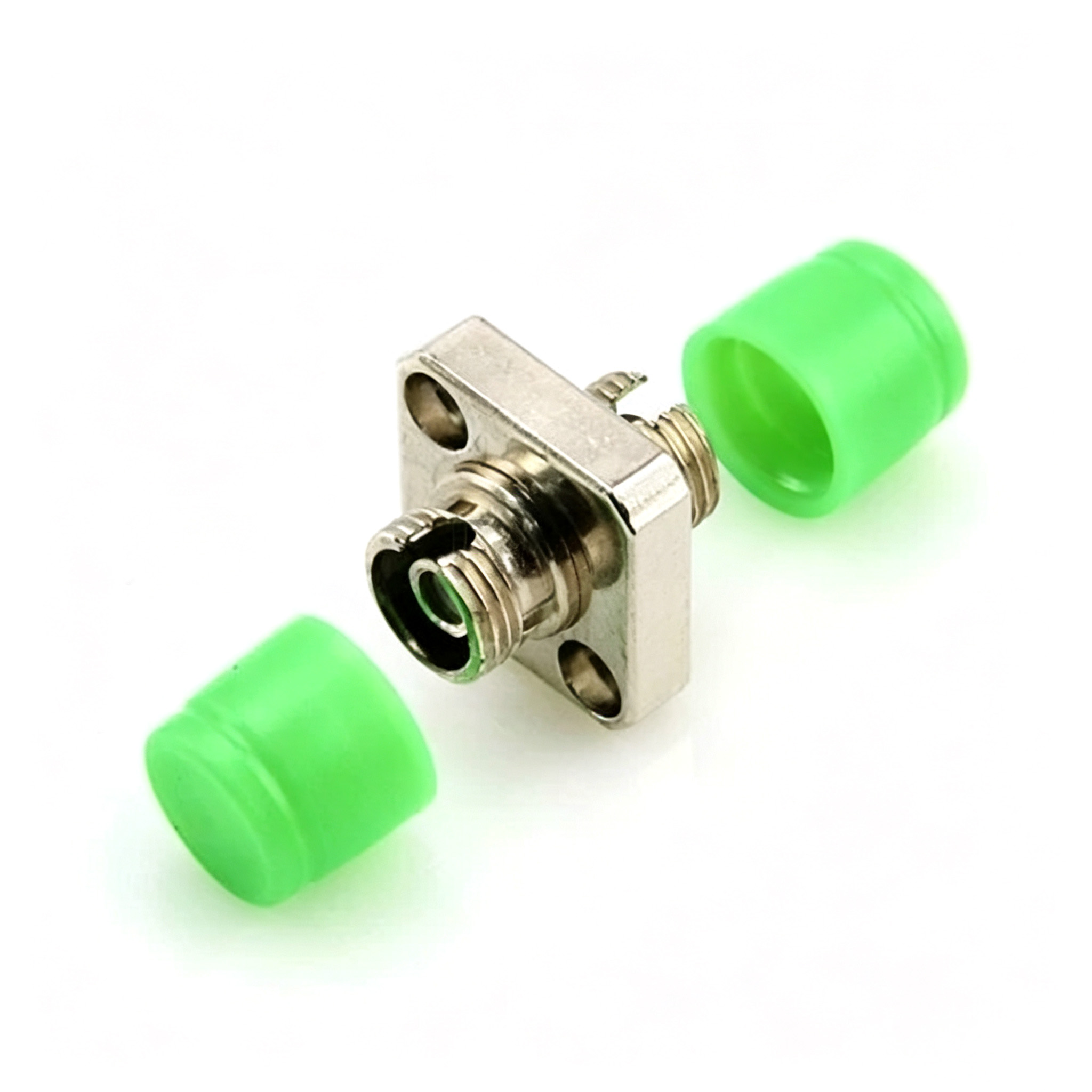
An FC/APC to FC/APC fiber adapter is a female-to-female mating component used to connect two fiber optic cables or connect a cable to an FC/APC-equipped device.
Although the adapter does not contain optical fiber, it performs two important mechanical functions.
First, the internal alignment sleeve holds the two 2.5 mm connector ferrules in the correct lateral position. Proper concentric alignment helps minimize the offset between the two fiber cores.
Second, the keyway in the adapter controls the rotational position of the FC connectors.
This rotational alignment is particularly important for FC/APC connections because the ferrule endface is polished at an angle—typically 8 degrees. The angled surfaces must be oriented correctly when the two connectors are mated.
Therefore, the optical performance of an FC/APC connection depends not only on the connector endfaces but also on how accurately and consistently the adapter positions the two ferrules.
Why Can FC/APC Adapter Prices Vary So Much?
A standard adapter and a precision branded adapter may share the same interface, but that does not necessarily mean they provide the same level of manufacturing control or long-term consistency.
Several factors can influence the price.
1. Alignment-sleeve precision
The internal alignment sleeve is one of the most important parts of an FC/APC adapter. Most high-quality single-mode adapters use a split sleeve made from zirconia ceramic.
The sleeve must:
Center both 2.5 mm ferrules accurately
Apply sufficient and consistent holding force
Allow the ferrules to be inserted without excessive resistance
Return to its original position after the connectors are removed
Maintain its performance over repeated mating cycles
Two adapters may both be described as having a “zirconia ceramic sleeve,” but the sleeve dimensions, roundness, concentricity, surface quality, elasticity, and manufacturing tolerances may not be identical.
Small differences may not be obvious during a visual inspection. They become more important when the adapter is used for repeated measurements, frequent connector changes, or low-loss optical systems.
2. Repeatability rather than one favorable measurement
A low insertion-loss result from a single test does not demonstrate the overall quality of an adapter.
For example, a generic adapter may achieve a very low result with one particular pair of connectors. The more important questions are:
Will another adapter from the same batch produce a similar result?
Will the result remain stable after disconnecting and reconnecting the cables?
Will the next production batch perform consistently?
Will the sleeve maintain its alignment after hundreds of mating cycles?
How much measurement variation will occur between repeated connections?
In production and laboratory environments, repeatability can be more valuable than the lowest result obtained from one carefully selected sample.
The Firsol Seikoh Giken SNA-1 product page specifies a maximum insertion loss of 0.2 dB and durability of 1,000 mating cycles. The 0.2 dB figure is a specified maximum, not a claim that every connection will lose exactly 0.2 dB.
A supplier advertising a typical or selectively measured value of 0.05 dB is not necessarily offering a better product than a manufacturer specifying a dependable maximum of 0.2 dB. The test method, connector quality, wavelength, sample size, reference cable and acceptance criteria must be comparable before the figures can be evaluated fairly.
3. Mechanical construction
The adapter body helps maintain the relative position of the keyway, alignment sleeve and connector threads.
A well-manufactured metal housing can provide:
Stable connector engagement
Consistent keyway positioning
Resistance to deformation
Reliable panel installation
Better durability during repeated handling
Consistent dimensions between production batches
The SNA-1 uses a metal housing and precision zirconia split sleeve. Seikoh Giken identifies dedicated part numbers for each key configuration and provides corresponding technical documentation.
A standard square solid one-piece metal FC/APC adapter may also offer reliable performance in normal network installations. However, its suitability for precision applications depends on its actual tolerances, test results and quality controls—not simply on whether its housing is made from one piece of metal.
4. Documentation and traceability
Precision components are frequently selected by exact manufacturer part number rather than by a general product description.
This is important for:
OEM bills of materials
Laboratory equipment
Production test systems
Approved vendor lists
Product qualification
Maintenance and replacement
Long-term procurement
Seikoh Giken publishes separate SNA-1 part numbers for Wide Key and Narrow Key configurations. Its FC adapters are specified as complying with JIS C 5970 F01 and IEC 61754-13 and use precision zirconia split sleeves, according to the manufacturer’s FC adapter information.
The availability of an official part number, specification document and dimensional drawing reduces uncertainty when the same component must be purchased again.
5. Batch-to-batch consistency
An adapter that works well today may need to be replaced months or years later. If its manufacturer, keyway dimensions or sleeve tolerances are not clearly controlled, the replacement may not behave exactly like the original.
For an ordinary patch-panel connection, this difference may be insignificant. For an optical test port or calibrated production fixture, it may affect measurement consistency.
A recognized manufacturer’s premium is therefore partly associated with predictable sourcing and process control—not only the physical adapter in the package.
What Is the Seikoh Giken SNA-1?
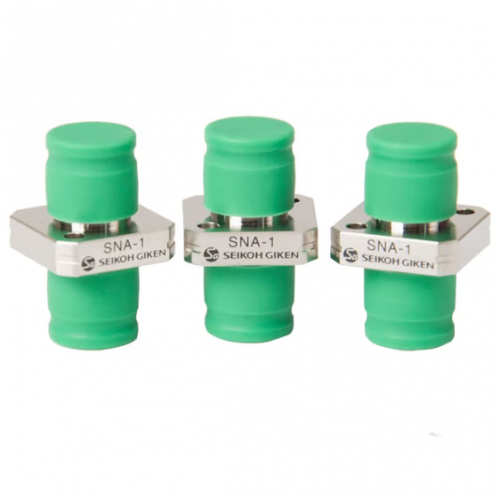
The Seikoh Giken SNA-1 is a standard-body FC adapter designed for angled physical contact connections.
It is available in two principal versions:
SNA-1 version | Manufacturer part number | Key configuration |
|---|---|---|
N-type | SNA-1224D0G | Wide Key |
R-type | SNA-1224K0G | Narrow Key |
Both versions connect FC/APC to FC/APC. The difference is the width of the connector-positioning keyway.
This distinction is easy to overlook because Wide Key and Narrow Key connectors look very similar. Nevertheless, the difference can be important in precision optical systems.
What Are Wide Key and Narrow Key FC/APC Connectors?
An FC connector has a small anti-rotation key on its body. When the connector is inserted, this key enters the corresponding keyway in the adapter.
Two key formats are commonly encountered in precision FC systems:
Narrow Key, often described nominally as 2.0 mm
Wide Key, often described nominally as 2.2 mm
Seikoh Giken identifies them as R-type and N-type respectively.
The manufacturer provides the following detailed dimensions:
Key type | Connector-side key width | Adapter-side keyway width | Seikoh Giken designation |
Narrow Key | 2.02 mm, with specified tolerance | 2.03 mm, with specified tolerance | R-type |
Wide Key | 2.14 mm, with specified tolerance | 2.15 mm, with specified tolerance | N-type |
Other suppliers frequently round these categories to 2.0 mm and 2.2 mm. For example, Thorlabs identifies FC components as using either a 2.0 mm Narrow Precision Key or 2.2 mm Wide Precision Key.
These figures refer to the rotational key and keyway—not the ceramic ferrule. Both connector types normally use a 2.5 mm ferrule.
Why Does Key Width Matter More for FC/APC?
With an APC connector, the ferrule endface is polished at an angle. The connector key establishes the rotational orientation of that angled surface.
If there is excessive clearance between the connector key and adapter keyway, the connector may rotate slightly before it is tightened. This can change the relative angular position of the two APC endfaces.
Potential effects include:
Less consistent physical contact
Greater insertion-loss variation
Changes in back-reflection performance
Reduced repeatability after reconnection
Measurement variation in laboratory systems
The actual result depends on the complete connection, including connector tolerances, endface geometry, cleanliness and mating force. Keyway clearance is only one factor, but it is a factor that precision adapter manufacturers can control.
Key alignment can be especially important when FC connectors are used with polarization-maintaining fiber, fiber collimators, lasers or other components whose optical orientation is related to the connector key.
Can Wide-Key and Narrow-Key Components Be Mixed?
Wide Key and Narrow Key should be treated as separate mechanical configurations unless the manufacturer explicitly states that a component supports both.
The general relationship is:
Connector key | Adapter keyway | Expected result |
Narrow | Narrow | Correct matched configuration |
Wide | Wide | Correct matched configuration |
Wide | Narrow | Normally will not fit |
Narrow | Wide | May physically fit, but additional rotational clearance can occur |
A Narrow Key connector may enter a Wide Key adapter because its key is smaller. However, physical insertion does not mean that the combination provides optimum angular positioning.
For routine power transmission, the connection may appear to work normally. For a test system, PM assembly or alignment-sensitive optical device, the additional rotational play may reduce repeatability.
There are also specialized adapters with different keyway sizes on their two sides. Therefore, the manufacturer’s drawings and compatibility information should always take priority over a general rule.
Why Do Many Generic FC/APC Adapters Not List a Key Type?
A product such as an “OS2 Single Mode Simplex FC/APC to FC/APC Square Solid Type One Piece Metal Fiber Adapter” may be offered without a Wide Key or Narrow Key selection.
That does not mean the adapter has no defined keyway. Several explanations are possible.
The manufacturer uses one default key type
The adapter may be manufactured only in the key configuration most commonly requested by that supplier’s customers. The specification was simply omitted from the product title.
The adapter uses a relatively wide keyway
Some general-purpose adapters use a keyway that can physically accept Narrow Key connectors and possibly other common FC connector variants. This simplifies inventory and increases practical compatibility.
The trade-off may be greater rotational clearance with a narrower connector key.
The product is intended for routine telecommunications use
In a conventional communication link, the main priorities may be acceptable insertion loss, secure mechanical connection and reasonable durability.
If the connection is installed once and rarely disturbed, small differences in reconnection repeatability may not affect system operation.
The supplier has not published enough dimensional information
Some products are listed only by connector type, sleeve material and housing style. The keyway dimension may exist on the manufacturing drawing but not on the sales page.
Therefore:
“Key type not specified” does not mean that Wide Key and Narrow Key are irrelevant. It means the buyer does not yet have enough information to confirm the configuration.
For applications in which key orientation matters, the correct approach is to ask the supplier for the actual keyway width or engineering drawing.
Does the Adapter Determine the Return Loss?
Not by itself.
An FC/APC adapter does not create the angled polish and should not be credited alone with producing a particular return-loss value. Return loss is strongly influenced by:
APC endface angle
Fiber height
Radius of curvature
Apex offset
Surface defects
Connector cleanliness
Fiber-core alignment
Physical contact between the ferrules
Key orientation and rotational clearance
A precision adapter can help the connectors maintain proper alignment and contact, but it cannot compensate for dirty, damaged or poorly polished connector endfaces.
Claims such as “high return loss adapter” should therefore be interpreted as describing the adapter’s suitability for high-return-loss connections—not as proof that the adapter independently guarantees the complete link’s return loss.
Is the SNA-1 Always Better Than a Standard FC/APC Adapter?
Not necessarily for every application.
A properly manufactured generic FC/APC adapter can perform very well in standard optical networks. Choosing the more expensive product is justified only when its additional controls and documentation provide meaningful value.
A standard adapter may be sufficient for:
General fiber distribution
Patch panels
Cost-sensitive network installations
Connections that are rarely disconnected
Systems with a comfortable optical power budget
Applications without strict measurement-repeatability requirements
A precision SNA-1 adapter is more likely to justify its cost in:
Optical laboratories
Insertion-loss test stations
Optical component manufacturing
Calibration systems
Laser and amplifier systems
OEM instruments
Frequently accessed test ports
Alignment-sensitive assemblies
Applications requiring a controlled Wide or Narrow Key interface
Projects requiring traceable manufacturer part numbers
The decision should be based on application risk and performance requirements rather than price alone.
What Are Customers Really Paying for?
Customers selecting the Seikoh Giken SNA-1 are not necessarily paying for dramatically lower loss in every individual connection.
They are primarily paying for greater confidence in:
Alignment-sleeve precision
Keyway dimensions
Mechanical fit
Reconnection repeatability
Manufacturing consistency
Defined Wide Key and Narrow Key configurations
Published specifications
Recognizable part numbers
Long-term replacement compatibility
In a laboratory or production environment, an unstable adapter can create costs far greater than its purchase price. A small measurement change may lead to repeated testing, troubleshooting, unnecessary connector cleaning or incorrect rejection of a fiber optic component.
The premium is therefore best understood as a reduction in uncertainty and operational risk.
How to Select the Correct FC/APC Adapter
Before ordering an FC/APC adapter, follow these steps.
1. Confirm the connector polish
Verify that both connectors are FC/APC. Do not assume that an adapter intended for FC/PC or FC/UPC is suitable simply because the threads appear compatible.
2. Identify the connector key width
Check the cable, device specification or connector drawing for:
Narrow Key or R-type
Wide Key or N-type
Nominal 2.0 mm or 2.2 mm key
Do not rely on connector color alone.
3. Match the adapter keyway
For the most controlled connection, use:
Narrow Key connector with Narrow Key adapter
Wide Key connector with Wide Key adapter
4. Check the alignment-sleeve material
A precision zirconia ceramic split sleeve is generally preferred for single-mode alignment and repeated mating.
5. Compare specifications correctly
Determine whether insertion loss is presented as:
Typical
Maximum
Tested value
Guaranteed value
Numbers obtained under different test conditions should not be compared directly.
6. Consider how often the port will be used
A permanent network connection and a laboratory test port do not experience the same mechanical demands.
7. Review documentation requirements
If the adapter will be included in an OEM product or controlled production system, confirm the manufacturer part number, dimensional drawing and future availability.
Frequently Asked Questions
Is every FC/APC connector Narrow Key?
No. Both Narrow Key and Wide Key FC/APC components are available. Narrow Key is common in many fiber cables and laboratory products, while some instruments, collimators, lasers and other optical components use Wide Key.
Always check the equipment specification.
Can a Wide Key FC/APC connector fit into a Narrow Key adapter?
Normally, no. The connector key is wider than the adapter keyway.
Do not force the connector into the adapter because this may damage the key, housing or alignment mechanism.
Can a Narrow Key connector fit into a Wide Key adapter?
It may physically fit, but the wider keyway can provide more rotational clearance. This combination is not recommended when precise APC angular positioning or connection repeatability is required.
Are Wide Key and Narrow Key related to the ferrule diameter?
No. Both normally use a 2.5 mm FC ferrule. The terms refer to the width of the connector’s anti-rotation key and the corresponding adapter keyway.
Does a lower advertised insertion-loss number always indicate a better adapter?
No. You must determine whether the value is typical, maximum or guaranteed and whether the products were tested using equivalent methods.
Repeatability, sample variation, durability and batch consistency are also important.
Can the same adapter be used for FC/UPC and FC/APC?
Some wide-key mating adapters may be described by their manufacturers as mechanically compatible with both FC/PC and FC/APC connectors. However, FC/UPC and FC/APC connectors must never be mated directly to each other.
Their endface geometries are different, and direct UPC-to-APC mating can result in poor physical contact, excessive loss, reflection or endface damage. Use an adapter only to connect matching polish types unless the complete interface is specifically designed otherwise.
When should an FC/APC adapter be replaced?
Consider replacing it when:
Insertion loss becomes unstable
Reconnection results become inconsistent
Connector fit becomes loose
The keyway is damaged
The ceramic sleeve is cracked or contaminated
Cleaning no longer restores performance
The adapter has exceeded the qualified mating-cycle requirement
Conclusion
FC/APC adapters may look like simple mechanical couplers, but their dimensional accuracy can influence the alignment and repeatability of the entire connection.
For ordinary network installations, a qualified standard FC/APC adapter may provide all the performance the system requires. For laboratories, production test systems, optical instruments and alignment-sensitive applications, the additional consistency and documentation of a precision adapter can justify the higher price.
The Seikoh Giken SNA-1 also makes an important specification visible: FC/APC interfaces can use either a Wide Key or Narrow Key. Generic adapters that do not list this information still have a physical keyway, but buyers may need to request the drawing or dimension before confirming compatibility.
Ultimately, the best adapter is not always the least expensive or the most expensive one. It is the adapter whose sleeve precision, key configuration, durability and documentation match the requirements of the application.
Firsol supplies the Seikoh Giken SNA-1 FC/APC to FC/APC Fiber Adapter in both Wide Key and Narrow Key versions. If you are unsure which configuration matches your cable or optical equipment, contact the Firsol team with the connector or equipment model before ordering.